The match traveled all the way to the brink of excitement—two set points for Mr. Sauce in the second—only to be turned back to the routine at the last second. It's funny how differently we can perceive the quality of the same set of events: From my view in the stadium, I would have graded the match at B; in their pressers, Federer and Verdasco each said that the level of play had been poor; but watching a few games on a TV at my hotel later, it looked like fantastic, fast-paced tennis. The two people watching near me were certainly impressed. They were almost falling off their chairs at some of the rallies. "Look at Federer," a woman exulted, "he knows everything!" I thought I'd already heard all the compliments I would ever hear about the man, but that one was new. - Steve Tignor. How odd is it that lost amid the ridiculously frivolous and endearingly indignant pages of a tennis message board is a piece of writing so loaded with sparkling wit and understated humour that it almost seems like the work of an accomplished genius. Then again, Steve Tignor probably is a writing genius. I've been reading his columns on the site www.tennis.com since about a year and I can't stop marveling at the remarkable variety and flowing arrangement of thoughts in his articles that keep you hooked right till the very end. It helps, of course, that a large number of his columns are dedicated to the ubiquitous Mr. Federer.
Why am I doing this? Why must I insist on talking about Roger Federer when the tennis story of the week is clearly the frightfully machine-like march of Rafael Nadal towards greatness and unmatched glory? Nadal dusted off Andy Murray 6-1,6-2 in the final of the Indian Wells Masters tournament, the same Murray who's lately taken to giving Federer all sorts of fits while establishing a 6-2 head-to-head record against the possible GOAT (Greatest Of All Time, for the uninformed). Federer is no longer the No. 1 player in the world, he's lost his last 5 matches against Nadal, he's not getting any younger at 27 and is probably unlikely to ever add the elusive French Open crown to his collection of Grand Slam titles. At what point does the man stop being the most illustrious fodder for news, speculation and opinion?
Admittedly, Federer's PR team hasn't exactly been doing its best to keep things low-key. Federer's heart-tugging show of emotion after being vanquished by Nadal in the Australian Open final set the ball rolling (to be fair, however, Federer's PR team probably had nothing to do with Federer's tears, judging by the almost universal bad press heaped on the man after the incident); then came the 'leak' of the fact that Federer's back still wasn't 100 % healed after the injury he suffered last fall. If that weren't enough, Federer's team decided to let the world know that he was flirting with the idea of hiring Darren Cahill, the man widely regarded as the ideal match for Federer's understated dedication to the sport, as a coach - reports about the training sessions the two were having together in Dubai were stealthily and steadily fed to eager ears, leading to much wagging of tongues and scratching of heads. Excitement and joy among Federer fans at this development rose to a fever-pitch, until the bubble was burst with Federer announcing, with a perfectly straight face, that Cahill had turned down the job. Finally, of course, came the big news - Federer and his girlfriend Mirka were expecting their first child "in the summer". Is it just me, or do all of these announcements seem calculated to keep the 13-time Grand Slam champion in the heart of all tennis news? Federer's PR guys must be working overtime. And yet, they needn't have, because Federer is news no matter what he says or does or doesn't say or doesn't do - minor collateral damage that comes from winning 13 Grand Slams and being ranked No.1 for 237 consecutive weeks. It's hard to keep off the name Roger Federer when you're trying to write anything even remotely connected to tennis, and my poor little blog is no exception.
Is Federer being unreasonably stubborn about his game in this inevitable period of his career - the period of decline? Experts have been saying for years that Federer's one-handed backhand, while a breathtakingly gorgeous tennis shot, is simply incapable of holding its own in extended crosscourt rallies to Nadal's viciously spinning forehand. And yet, Federer repeatedly insists on trying to trade beautiful backhands for crushing forehands in nearly every rally of every match he plays against Nadal, often to less than spectacular results. Federer doesn't use his almost-legendary backhand slice nearly enough in his matches against Nadal, and no one seems to know why. His second serve returns continue to be bunted back rather than blasted to the lines the way most experts want him to. Is there really a simple explanation for all of these apparent acts of idiocy? There's been a lot of talk of Nadal's willingness to adapt his game, his style, even himself, to the necessities of battle. In other words, Nadal will do anything to win, and will take a win no matter how it comes about. Roger Federer, on the other hand, gives off the impression that he wants to win in his own style. And while this may seem like a counter-productive attitude at the moment, I believe that when all is said and done, history will reflect kindly on this line of thinking of Federer's.
Federer has always been a traditionalist - the awe and respect that he accords to the game's greats like Rod Laver and Bjorn Borg stand testimony to this fact. But Federer has also been a connoiseur of style and beauty. His one-handed backhand, which is both a devastating asset and a fragile liability at the same time, is perhps the best evidence of this. I can almost imagine an exasperated coach urging a 6-year-old Roger to use both hands on his backhand to gain greater control and power, but to no avail, because little Roger would keep saying "but it looks so much prettier when I use one hand!" Much has been written about Federer's almost balletic movement on the court - people have been known to say that Federer looks like he's flying when he's running around on the court; the term 'full-flight Federer' could not have been more apt for the man on one of his good days. His right hand, while capable of cutting a swathe through the court with a scorching forehand, also has remarkable touch and finesse - his volleys and dropshots are more aesthetic than seems possible for tennis shots. Is it possible, even conceivable, that Federer would have preserved all of these abilities if he had been as willing as Nadal to adapt to the necessities of battle? Would his forehand have looked as majestic if he had learned to put more topspin on it to reduce the errors that now flow so liberally off it? Would his brand of tennis been as eye-pleasing and attractive as it has been over the years if he had been content to lapse into 30-shot rallies built on patience and perseverance?
Federer is a gifted athlete who probably believes he has the divine right to defeat every man across the net from it. While there may be considerably more than a touch of arrogance in that belief, it cannot be denied that it has given us some of the most spectacular tennis that has ever been seen in history. His period of dominance, from 2004 to 2007, will likely be held up as the most magnificent exhibition of artistry and brilliance by any man or woman to have held a racquet. And those glory years would never have happened if Federer hadn't believed, from the outset, that his backhand could hold up against any shot that could be produced by even the most gifted of tennis players. Arrogance is sometimes necessary to become a champion, and so is being a sore loser. Just ask Serena Williams. A player like Rafael Nadal, on the other hand, seems to summon his fighting abilities from the belief that he may not possess a counter for every strike that his opponent throws at him, but he'll find a way to win by constantly improving every single skill he knows. These are two very different, almost diametrically oppposite ways to approach a contest, and the question as to which approach is the more effective one can probably only be answered when the careers of both Federer and Nadal are over.
Federer may likely never regain his form of old, and he may never defeat Nadal or Murray again. Why, he may never even win another Grand Slam title again. But that's alright, because he won all that he could when he played in his own style. And that style was a joy to behold.
P.S. If this post seems like a thinly disguised way to put a positive spin to Federer's depressing run of results of late, then I plead guilty.
Showing posts with label Roger Federer. Show all posts
Showing posts with label Roger Federer. Show all posts
Monday, March 23, 2009


Monday, July 7, 2008
THE Match
Clearly, there's not much I can say about Sunday's match between Roger Federer and Rafael Nadal that will add anything whatsoever to the myriads of columns, articles, opinions and reactions that have already been voiced and written by all sorts of people all over the world. It doesn't help, of course, that I am actually at a loss for words to do adequate justice to the match that was of such epic proportions that it still seems a little beyond belief. Which is why I think I'll put aside any thoughts of an objective analysis or technical evaluation of the match and instead, write about it purely from the perspective of a Roger Federer fan. It might be a little more painful, but it will surely be more fruitful, no? (Forgive the Nadal imitation; it's become something of trend to add a 'no' at the end of every sentence these days).
Some people are calling this the greatest match in the history of tennis, and nearly everybody agrees that this was the defining match of our generation. Was it better than the Borg-McEnroe Wimby final of 1980? The jury is still out on that, but certainly, this match had everything, if having everything is the basis on which such things are judged. It had a confident, assured start by Nadal which served as an appetizing teaser; a stirring comeback by Federer to keep the ball rolling, and a relentless, hit-till-you-drop 5th set that took the rivalry to as dizzying a pinnacle as anyone could have hoped for. Throw in a couple of dramatically timed rain delays and a finish in near darkness with the flashbulbs of innumerable cameras sparkling upon the court like some kind of divine rapture from the skies and you have a transcendent sporting moment that will perhaps never be witnessed again. When the match finally ended after 4 hours and 48 minutes - incidentally, this was the longest-ever Wimbledon final - and Nadal fell to the ground in part relief, part disbelief, and part life-changing ecstasy, did anyone even remember the extremely high stakes that had rested on the match, the remarkable slice of history that Federer had been denied or the extraordinary accomplishment (the French-Wimby double that hasn't been seen since the days of, oh, Bjorn Borg and 1980) that Nadal had just achieved?
For a Federer fan, the match provided plenty of moments to savour and keep in memory, although I'm sure most Federer fans would actually want to quickly forget this match in its entirety. Federer began the match as badly as anyone could have feared, and seemed to realize soon enough that he would have to summon his TMF (TMF=The Mighty Federer, a delightful little term coined by members of the site www.tennis.com) mode to make a match of this. And summon TMF mode he did, racing away to a 4-2 lead in the second, seemingly gaining control of proceedings. But Nadal, in what has become scarily customary manner now, staged a brilliant comeback, and all of a sudden memories of Roger letting slip those 4-0 and 5-1 leads in Monte Carlo and Hamburg came painfully rushing back. Almost expectedly, Federer's level dropped, and by the middle of the 3rd set he was shanking backhands all over the place. At 3-3 in the third, Federer went 0-40 down on his serve, and even the most optimistic of Federer fans must have given up hope then (I know I almost switched off the TV after Nadal took the second set). But Federer's serve, as it has so often required to do throughout his career, bailed him out, and Federer survived. His bad temper lingered, however, and in the next game he let his grumpy side come out in full force, making such ridiculous challenges on baseline calls right at his feet that it seemed he was going prematurely senile. Muttering and grumbling away in typical Federer fashion, he somehow managed to hang in there till the rains came pouring down, giving him a much needed break for perhaps a few calming words from girlfriend Mirka and a cooling off under some ice cold water. When play resumed, of course, TMF mode was back, and he took the 3rd before most people watching it at home had even realized that the match had resumed.
The 4th set tie-breaker was perhaps the most spectacular display of tennis and spell-binding drama that anyone will ever get to see. Leading 5-2 with two serves in hand, Nadal choked; a double fault was followed by a backhand error, and when a player as mentally strong as Nadal chokes, you know that the match means much, much more than a Grand Slam title or 1000 ranking points. Federer then got yet another opportunity to show why Wimbledon is supposed to be his house, striking a backhand passing winner down the line on championship point. It was a shot so unforgettable and so unfreakingbelievable that it seemed like a travesty when they continued to the next point, instead of giving the TV broadcasters time to show maybe a 100 replays of it.
When the match went to a 5th set the general feeling was that the momentum had swung irrevocably in Federer's favour, and when Nadal went down a break point at 4-3, it seemed only a matter of time before the 6th consecutive title was in Federer's fashionable little bag. But Nadal had other ideas, keeping up his magnificent serving and refusing to let Federer get another sniff, in spite of the distinct disadvantage that he had of serving behind in the final set. Federer frequently went down double break points on his own serve, and with every ace or service winner that he thundered down on these points, the Nadal fans all over the world must have been trying their hardest not to remember those squandered break points from last year's final. After a point it got so, I don't know, routine that I could only laugh in amazement every time Federer fired yet another ace when he was in trouble on his serve. Has there ever been a better example of clutch serving in the history of tennis? I guess I'll have to dig out some of those Pete Sampras clips on youtube to answer that. Eventually, of course, Federer could not keep up in the face of the unremitting attacks by the Spaniard, and Nadal finally had the break to go up 8-7. And yet, there was more drama in store. Down another championship point at 7-8, 30-40, Federer came up with a return of serve that one commentator described as "the best return of serve that I've ever seen", only to falter a few moments later when an errant forehand found the net. Tell me, what did this match not have?
I didn't have the heart to watch the post-match ceremony, switching off the TV after Nadal had climbed down from the stands having embraced and rejoiced and cried with his support team. Federer looked so forlorn and lost that it seemed almost an invasion into his privacy to even watch him sitting on his chair, staring blankly into oblivion and trying, and failing, to look unbroken by the result of the match. I've been told that he almost broke into tears during an interview with John McEnroe some time after the match, and I'm fervently thankful that I didn't have to see that. Why was this match so important? Surely, Federer will have many more chances to win Wimbledon. Undeniably, Nadal has many more years to prove and reinforce his mastery over grass, if he hadn't already done that before this match. Even the rankings haven't been greatly affected by the result - it's still highly likely that Federer will end the year ranked No. 1. On Sunday, the Federer-Nadal rivalry touched its zenith, a dazzling peak that will perhaps remain untouched and forever ensconced in folklore and legend, and it was a crest that transcended all cause and reason. It was sport in its purest, most enthralling form. After the match, I felt really really sorry for Federer, but I felt sorrier for all the people in the world who don't have the chance, or in some cases don't want, to watch and witness the glory of sport.
P.S.: I also feel sorry for Venus Williams, whose remarkable 5th Wimbledon crown and the fantastic final she put up with sister Serena are destined to be forgotten and relegated to the after-thoughts heap in the face of the incredible, incredible men's final.
Some people are calling this the greatest match in the history of tennis, and nearly everybody agrees that this was the defining match of our generation. Was it better than the Borg-McEnroe Wimby final of 1980? The jury is still out on that, but certainly, this match had everything, if having everything is the basis on which such things are judged. It had a confident, assured start by Nadal which served as an appetizing teaser; a stirring comeback by Federer to keep the ball rolling, and a relentless, hit-till-you-drop 5th set that took the rivalry to as dizzying a pinnacle as anyone could have hoped for. Throw in a couple of dramatically timed rain delays and a finish in near darkness with the flashbulbs of innumerable cameras sparkling upon the court like some kind of divine rapture from the skies and you have a transcendent sporting moment that will perhaps never be witnessed again. When the match finally ended after 4 hours and 48 minutes - incidentally, this was the longest-ever Wimbledon final - and Nadal fell to the ground in part relief, part disbelief, and part life-changing ecstasy, did anyone even remember the extremely high stakes that had rested on the match, the remarkable slice of history that Federer had been denied or the extraordinary accomplishment (the French-Wimby double that hasn't been seen since the days of, oh, Bjorn Borg and 1980) that Nadal had just achieved?
For a Federer fan, the match provided plenty of moments to savour and keep in memory, although I'm sure most Federer fans would actually want to quickly forget this match in its entirety. Federer began the match as badly as anyone could have feared, and seemed to realize soon enough that he would have to summon his TMF (TMF=The Mighty Federer, a delightful little term coined by members of the site www.tennis.com) mode to make a match of this. And summon TMF mode he did, racing away to a 4-2 lead in the second, seemingly gaining control of proceedings. But Nadal, in what has become scarily customary manner now, staged a brilliant comeback, and all of a sudden memories of Roger letting slip those 4-0 and 5-1 leads in Monte Carlo and Hamburg came painfully rushing back. Almost expectedly, Federer's level dropped, and by the middle of the 3rd set he was shanking backhands all over the place. At 3-3 in the third, Federer went 0-40 down on his serve, and even the most optimistic of Federer fans must have given up hope then (I know I almost switched off the TV after Nadal took the second set). But Federer's serve, as it has so often required to do throughout his career, bailed him out, and Federer survived. His bad temper lingered, however, and in the next game he let his grumpy side come out in full force, making such ridiculous challenges on baseline calls right at his feet that it seemed he was going prematurely senile. Muttering and grumbling away in typical Federer fashion, he somehow managed to hang in there till the rains came pouring down, giving him a much needed break for perhaps a few calming words from girlfriend Mirka and a cooling off under some ice cold water. When play resumed, of course, TMF mode was back, and he took the 3rd before most people watching it at home had even realized that the match had resumed.
The 4th set tie-breaker was perhaps the most spectacular display of tennis and spell-binding drama that anyone will ever get to see. Leading 5-2 with two serves in hand, Nadal choked; a double fault was followed by a backhand error, and when a player as mentally strong as Nadal chokes, you know that the match means much, much more than a Grand Slam title or 1000 ranking points. Federer then got yet another opportunity to show why Wimbledon is supposed to be his house, striking a backhand passing winner down the line on championship point. It was a shot so unforgettable and so unfreakingbelievable that it seemed like a travesty when they continued to the next point, instead of giving the TV broadcasters time to show maybe a 100 replays of it.
When the match went to a 5th set the general feeling was that the momentum had swung irrevocably in Federer's favour, and when Nadal went down a break point at 4-3, it seemed only a matter of time before the 6th consecutive title was in Federer's fashionable little bag. But Nadal had other ideas, keeping up his magnificent serving and refusing to let Federer get another sniff, in spite of the distinct disadvantage that he had of serving behind in the final set. Federer frequently went down double break points on his own serve, and with every ace or service winner that he thundered down on these points, the Nadal fans all over the world must have been trying their hardest not to remember those squandered break points from last year's final. After a point it got so, I don't know, routine that I could only laugh in amazement every time Federer fired yet another ace when he was in trouble on his serve. Has there ever been a better example of clutch serving in the history of tennis? I guess I'll have to dig out some of those Pete Sampras clips on youtube to answer that. Eventually, of course, Federer could not keep up in the face of the unremitting attacks by the Spaniard, and Nadal finally had the break to go up 8-7. And yet, there was more drama in store. Down another championship point at 7-8, 30-40, Federer came up with a return of serve that one commentator described as "the best return of serve that I've ever seen", only to falter a few moments later when an errant forehand found the net. Tell me, what did this match not have?
I didn't have the heart to watch the post-match ceremony, switching off the TV after Nadal had climbed down from the stands having embraced and rejoiced and cried with his support team. Federer looked so forlorn and lost that it seemed almost an invasion into his privacy to even watch him sitting on his chair, staring blankly into oblivion and trying, and failing, to look unbroken by the result of the match. I've been told that he almost broke into tears during an interview with John McEnroe some time after the match, and I'm fervently thankful that I didn't have to see that. Why was this match so important? Surely, Federer will have many more chances to win Wimbledon. Undeniably, Nadal has many more years to prove and reinforce his mastery over grass, if he hadn't already done that before this match. Even the rankings haven't been greatly affected by the result - it's still highly likely that Federer will end the year ranked No. 1. On Sunday, the Federer-Nadal rivalry touched its zenith, a dazzling peak that will perhaps remain untouched and forever ensconced in folklore and legend, and it was a crest that transcended all cause and reason. It was sport in its purest, most enthralling form. After the match, I felt really really sorry for Federer, but I felt sorrier for all the people in the world who don't have the chance, or in some cases don't want, to watch and witness the glory of sport.
P.S.: I also feel sorry for Venus Williams, whose remarkable 5th Wimbledon crown and the fantastic final she put up with sister Serena are destined to be forgotten and relegated to the after-thoughts heap in the face of the incredible, incredible men's final.
Monday, May 19, 2008
Sport in All Its Fascinating Glory
I had sworn I wouldn't write about tennis at least until the French Open got underway, but guess what, I'm notoriously bad at sticking to resolutions. And besides, the tennis world hasn't exactly been lacking in sensational developments lately, has it? Ok, I'll admit that Justine Henin's retirement from tennis wasn't as big a shock as some tennis analysts seem to think it was, but it was huge news anyway. Let's leave Henin and her motivational problems aside for a bit though, because right now all I can think of is of Roger Federer and his ridiculously captivating quest to solve the Rafael Nadal puzzle on clay. The Hamburg final yesterday between the world's top two players looked very much like a repeat of their Monte Carlo final three weeks ago, which Nadal won 7-5, 7-5 after being down 2-4 in the first set and 0-4 in the second, but yesterday was, for Federer fans at least, infinitely more satisfying and more disappointing at the same time. That may sound like a paradoxical statement, but if you watched the match, you'll know what I'm talking about. How can you not admire Federer for playing such sublime tennis that he got to leads of 5-1 and 5-2 respectively in the first two sets against the superhuman king of clay Nadal? And yet, how can you not be infuriated that Federer blew both those leads through some very poor serving in crucial games?
The final score went 7-5, 6-7, 6-3 in Nadal's favour, and for some reason I wasn't as depressed at the end of the match as I thought I would be. Part of the reason for that could be that I was rapturously happy that it went to a third set at all after Federer went 0-40 down on his serve at 5-5 in the second. Some mighty fine serving got him out of that hole, and then he ran away with the tie-breaker, restoring some of my faith in his ability to play well on the big points. But I think the main reason why I'm not so gloomy right now is because Federer seems to be playing like a claycourter for the first time in memory, and he finally seems to have discovered the right strategy to play Nadal. Those 5-1 and 5-2 leads mean nothing with respect to the result of the match, but I'm sure it's more than comforting for Federer fans to remember that those leads did happen; Federer is fully capable of dominating Nadal for reasonable stretches of time, and, short of a large bunch of crushing victories over Nadal on clay, I don't know what else can give Federer and his fans greater hope and confidence for the French Open. And to top that, Nadal maintained his grip on the No. 2 ranking by winning his semi-final against Novak Djokovic, which means that the terrifying prospect of Federer facing Nadal in the French semis has been firmly avoided. Comforting thoughts aplenty for the average Federer fan.
Speaking of Djokovic, I can't believe that I actually called it right when I said his semi-final match against Nadal may turn out to be the best match of the year. The tennis that the two put in the match was spell-binding, breathtaking, insanely riveting and spectacular all at the same time. The thing that was firmly established in my mind while watching it, however, is that when Nadal is at his best, it won't just take a superhuman effort by any player in the world, including Roger, to defeat him - it will take much, much more than that. Nadal's defense, particularly his incredibly steady forehand when pulled wide and his nearly-unfailing backhand passing shots simply defy belief. How do you defeat a player who refuses to let even the most ferociously well-timed potential winner convince him to give up the point? Djokovic played fabulously throughout the 3 hour long match - for the first time ever, I found myself feeling bad for him - and I have a feeling that the years of torture that Federer has faced on clay at the hands of Nadal will now be passed on to Djokovic. I guess if he wants to inherit the No. 1 ranking from Federer, he'll have to take on everything associated with Federer's famed legacy. Federer and Djokovic may do all that they can to adapt their games to suit clay and spend months practising on slow courts and hire the most adept and inspiring coaches to help them get their hands on the French trophy, but the truth is that Nadal will always be there, forever stalking their paths, eternally intimidating, absolutely relentless.
Someone who will not always be there, of course, is Justine Henin, who became the first woman in the history of tennis to retire while ranked No. 1 in the world. The thing with such premature retirements - Justine is still all of 25 years old - is that they invariably invite comparisons with Bjorn Borg's retirement back in 1982 (or was it 1983?) at the age of 26. For once, however, I think the comparisons are justified - both were at the top of their games when they bowed out, and both were thwarted in their attempts to capture the last bit of glory missing from their respective careers - the US Open for Borg, and Wimbledon for Justine. Justine actually went so far as to admit in her retirement press conference that she never believed she had it in her to win at Wimbledon, and that it was always a distant dream to her that never seemed within her reach. Perhaps that's what made it all the more desirable for the undisputed clay queen?
Then there's also Justine's admission that her win against Maria Sharapova at last year's year-end championships, the 4th-longest women's match in history which Henin won 5-7, 7-5, 6-3 after nearly 3 and 1/2 hours, took too much out of her both physically and mentally. Can anyone say Wimbledon final 1980? Borg won that match against John McEnroe after a titanic struggle and an epic 4th set tie-breaker that McEnroe won 18-16. Borg was never the same after that, losing 3 Grand Slam finals to McEnroe before formally announcing his retirement. It was the changing of the guard - McEnroe was a brash, arrogant, but also prodigiously gifted tennis player who was showing signs of embarking on a GOAT-worthy career - and Borg knew it. Did Justine Henin undergo the same thought process as Borg? Her crushing defeats at the hands of Sharapova and Serena Williams this year certainly point to that possibility. But then again, all of this analysis and theorizing is based entirely upon conjecture; there's no real way of knowing what exactly goes on in an athlete's mind, is there? Specially if the athlete in question is as reticent and guarded with the public as Henin. She said she had no 'fire' left in her to play tennis any more - and that could be because fighting and neutralizing the power games of her opponents took a heavy toll on her body and mind, but it could also be because of a totally personal matter that had nothing to do with tennis, or maybe she simply got bored of tennis, period. All I know is that these are the kind of poignant moments that we watch sport for - if sport was just going on the field and playing to win then there wouldn't be much charm in it, would there? Justine's retirement has been a fascinating subject to think and talk about. Almost as fascinating as Federer's already-legendary pursuit of that last bit of filthy silverware. Almost.
The final score went 7-5, 6-7, 6-3 in Nadal's favour, and for some reason I wasn't as depressed at the end of the match as I thought I would be. Part of the reason for that could be that I was rapturously happy that it went to a third set at all after Federer went 0-40 down on his serve at 5-5 in the second. Some mighty fine serving got him out of that hole, and then he ran away with the tie-breaker, restoring some of my faith in his ability to play well on the big points. But I think the main reason why I'm not so gloomy right now is because Federer seems to be playing like a claycourter for the first time in memory, and he finally seems to have discovered the right strategy to play Nadal. Those 5-1 and 5-2 leads mean nothing with respect to the result of the match, but I'm sure it's more than comforting for Federer fans to remember that those leads did happen; Federer is fully capable of dominating Nadal for reasonable stretches of time, and, short of a large bunch of crushing victories over Nadal on clay, I don't know what else can give Federer and his fans greater hope and confidence for the French Open. And to top that, Nadal maintained his grip on the No. 2 ranking by winning his semi-final against Novak Djokovic, which means that the terrifying prospect of Federer facing Nadal in the French semis has been firmly avoided. Comforting thoughts aplenty for the average Federer fan.
Speaking of Djokovic, I can't believe that I actually called it right when I said his semi-final match against Nadal may turn out to be the best match of the year. The tennis that the two put in the match was spell-binding, breathtaking, insanely riveting and spectacular all at the same time. The thing that was firmly established in my mind while watching it, however, is that when Nadal is at his best, it won't just take a superhuman effort by any player in the world, including Roger, to defeat him - it will take much, much more than that. Nadal's defense, particularly his incredibly steady forehand when pulled wide and his nearly-unfailing backhand passing shots simply defy belief. How do you defeat a player who refuses to let even the most ferociously well-timed potential winner convince him to give up the point? Djokovic played fabulously throughout the 3 hour long match - for the first time ever, I found myself feeling bad for him - and I have a feeling that the years of torture that Federer has faced on clay at the hands of Nadal will now be passed on to Djokovic. I guess if he wants to inherit the No. 1 ranking from Federer, he'll have to take on everything associated with Federer's famed legacy. Federer and Djokovic may do all that they can to adapt their games to suit clay and spend months practising on slow courts and hire the most adept and inspiring coaches to help them get their hands on the French trophy, but the truth is that Nadal will always be there, forever stalking their paths, eternally intimidating, absolutely relentless.
Someone who will not always be there, of course, is Justine Henin, who became the first woman in the history of tennis to retire while ranked No. 1 in the world. The thing with such premature retirements - Justine is still all of 25 years old - is that they invariably invite comparisons with Bjorn Borg's retirement back in 1982 (or was it 1983?) at the age of 26. For once, however, I think the comparisons are justified - both were at the top of their games when they bowed out, and both were thwarted in their attempts to capture the last bit of glory missing from their respective careers - the US Open for Borg, and Wimbledon for Justine. Justine actually went so far as to admit in her retirement press conference that she never believed she had it in her to win at Wimbledon, and that it was always a distant dream to her that never seemed within her reach. Perhaps that's what made it all the more desirable for the undisputed clay queen?
Then there's also Justine's admission that her win against Maria Sharapova at last year's year-end championships, the 4th-longest women's match in history which Henin won 5-7, 7-5, 6-3 after nearly 3 and 1/2 hours, took too much out of her both physically and mentally. Can anyone say Wimbledon final 1980? Borg won that match against John McEnroe after a titanic struggle and an epic 4th set tie-breaker that McEnroe won 18-16. Borg was never the same after that, losing 3 Grand Slam finals to McEnroe before formally announcing his retirement. It was the changing of the guard - McEnroe was a brash, arrogant, but also prodigiously gifted tennis player who was showing signs of embarking on a GOAT-worthy career - and Borg knew it. Did Justine Henin undergo the same thought process as Borg? Her crushing defeats at the hands of Sharapova and Serena Williams this year certainly point to that possibility. But then again, all of this analysis and theorizing is based entirely upon conjecture; there's no real way of knowing what exactly goes on in an athlete's mind, is there? Specially if the athlete in question is as reticent and guarded with the public as Henin. She said she had no 'fire' left in her to play tennis any more - and that could be because fighting and neutralizing the power games of her opponents took a heavy toll on her body and mind, but it could also be because of a totally personal matter that had nothing to do with tennis, or maybe she simply got bored of tennis, period. All I know is that these are the kind of poignant moments that we watch sport for - if sport was just going on the field and playing to win then there wouldn't be much charm in it, would there? Justine's retirement has been a fascinating subject to think and talk about. Almost as fascinating as Federer's already-legendary pursuit of that last bit of filthy silverware. Almost.
Monday, April 28, 2008
Back Without A Bang
Ok, I'll admit I can no longer stand the guilt that comes with not writing a post for over a month; I feel I can be brave enough to concede that the only reason I'm writing this is because every other blog writer I know continues to merrily write post after post without so much as a hint of a furrowed brow, while my blog has been languishing in the sorrowful shadows, unattended and ignored. Ugh, looks like the month-long hiatus has made my writing a little over-dramatic. But what the heck, as long as I'm writing something....
Perhaps the most significant development in the last one month, other than Hilary Clinton closing the gap on Barack Obama in the Democratic presidential race in the US, the previously unheard-of phenomenon of foodgrain scarcity scaring the living daylights out of Americans, Priyanka Gandhi meeting with one of the assassins responsible for her father's death, and our dear old MSEB announcing that Pune will not have to face load-shedding at least until September but deciding to subject Puneites anyway to frequent, painful power-cuts lasting anywhere between 5 seconds and 5 hours (whew, this is turning out to be one long sentence), has been the roaring success of the Indian Premier League, or IPL, to be more hep about it. Actually, 'roaring success' might be an understatement - there's something so enthralling, so rivetingly amusing about seeing those mighty Australian and South African players being meekly obedient to their Indian captains and eagerly putting in the yards to, oh, defeat just another State team filled with a bunch of second class Indian cricketers, that there never really should have been a doubt about the success of the tournament. It helps, of course, that the format of the tournament is eerily similar to that of the many football leagues in Europe that are so wildly popular with a small but substantial segment of Indian sports watchers. The IPL has done to cricket what a 100 years of Test cricket and 40 years of one-day cricket couldn't: it has made cricket, in every shallow and amateurish sense of the term, 'cool'. Way to go, BCCI!
In other news, the tennis clay season has begun, and the question that has enchanted and consumed tennis followers for the past 3 years has surfaced again: can Roger Federer beat Rafael Nadal at the French Open? Federer, for his part, seems to have overcome his early season hiccups by stringing together two consecutive finals appearances on his least favourite surface, notching up his first title of the year at Estoril before losing to Rafael Nadal in the final at Monte Carlo. Yeah, I know, nothing new or earth-shattering about that last bit - Federer losing to Nadal on clay has become somewhat of a given, has it not? What does surprise me, however, is the continued and insistent belief that Federer's supporters hold that he will, one day, manage to overcome the King of Clay at the French Open. I mean seriously, if you saw how much advice, not support, but advice that Federer gets before each match that he plays against Nadal from thousands of people who may never have wielded a racquet their whole lives , you'd think Federer was the prized protege of nearly half of the tennis-watching population of the world. Play the slice backhand. Use the forehand dropshot. Come to the net more often. Attack Nadal's second serve more aggressively. Improve your serving percentage. Some have even suggested switching over from a one-handed backhand (that gorgeous beauty of a shot) to a two-handed one. Even Jose Higueras, Federer's celebrated (?) new coach, hasn't been spared the 'expert' counsel. In the midst of all this, some rather more well-informed columnists gravely pronounce that Nadal on clay is a puzzle that cannot be solved; that Federer simply does not have the patience or fitness to get the better of the muscular Spaniard on dirt. How true is that last statement? Being a sworn Federer fan, I like to believe that it isn't in the least true; but it's all rather pointless for us to be armchair psychologists, is it not? At the end of the day Federer has to go out on the court and play solid tennis and outwit Nadal. Nothing more, nothing less. In the meantime, he can continue to delight us by displaying the kind of dazzling tennis that he put on show in his quarterfinal match against old nemesis David Nalbandian, and by handing out a few dozen more defeats to Novak Djokovic, preferably including several bagel sets. And of course, a few more moments like the "Be quiet, ok?" admonition that he shouted out to Djokovic's mother in their semi-final match at Monte Carlo. That was just so unexpected and so very wonderful. I mean, wow.
Watched a couple of Bollywood flicks last week, first Tashan, a strange movie that has all the right ideas but falls sorely short in execution. The first half is stylish and mildly interesting, the second half shoddy and exasperating. A shame, really, considering the extraordinary hype generated by the movie before its release and the oodles of hard work that must have been put in by Kareena Kapoor to achieve that thing called size zero. The other flick that I watched, U Me Aur Hum, is almost the reverse of Tashan - intolerably boring first half, mildly touching second half. Here too, the makers had a great premise, but the mandatory theatrics and Bollywood-style wooing sequences ruin things considerably. Kajol comes up with a vintage performance - even after all these years, she still holds, in my opinion, stomping rights to the mantle of being the best actress in Bollywood, and there are quite a few heart-rending scenes towards the end of the movie, but that's just about it. Just a thought: is the tagline of the movie, "Sometimes the greatest journey is the distance between two people" supposed to be a quote from an outside source, knowing as we do how the Ed Norton starrer The Painted Veil has the exact same tagline, or is this another pathetic attempt at thinly disguised plagiarism by Bollywood's dear old thieves?
Okay, for what seems like the umpteenth time, I seem to have run riot with my post - there's nothing more irritating than a post that never seems to end, is there? So I'll end right here - no conclusion, no dramatic parting line. Yes, this is it. The End. I quite like the ring of that. Hehehe.
Perhaps the most significant development in the last one month, other than Hilary Clinton closing the gap on Barack Obama in the Democratic presidential race in the US, the previously unheard-of phenomenon of foodgrain scarcity scaring the living daylights out of Americans, Priyanka Gandhi meeting with one of the assassins responsible for her father's death, and our dear old MSEB announcing that Pune will not have to face load-shedding at least until September but deciding to subject Puneites anyway to frequent, painful power-cuts lasting anywhere between 5 seconds and 5 hours (whew, this is turning out to be one long sentence), has been the roaring success of the Indian Premier League, or IPL, to be more hep about it. Actually, 'roaring success' might be an understatement - there's something so enthralling, so rivetingly amusing about seeing those mighty Australian and South African players being meekly obedient to their Indian captains and eagerly putting in the yards to, oh, defeat just another State team filled with a bunch of second class Indian cricketers, that there never really should have been a doubt about the success of the tournament. It helps, of course, that the format of the tournament is eerily similar to that of the many football leagues in Europe that are so wildly popular with a small but substantial segment of Indian sports watchers. The IPL has done to cricket what a 100 years of Test cricket and 40 years of one-day cricket couldn't: it has made cricket, in every shallow and amateurish sense of the term, 'cool'. Way to go, BCCI!
In other news, the tennis clay season has begun, and the question that has enchanted and consumed tennis followers for the past 3 years has surfaced again: can Roger Federer beat Rafael Nadal at the French Open? Federer, for his part, seems to have overcome his early season hiccups by stringing together two consecutive finals appearances on his least favourite surface, notching up his first title of the year at Estoril before losing to Rafael Nadal in the final at Monte Carlo. Yeah, I know, nothing new or earth-shattering about that last bit - Federer losing to Nadal on clay has become somewhat of a given, has it not? What does surprise me, however, is the continued and insistent belief that Federer's supporters hold that he will, one day, manage to overcome the King of Clay at the French Open. I mean seriously, if you saw how much advice, not support, but advice that Federer gets before each match that he plays against Nadal from thousands of people who may never have wielded a racquet their whole lives , you'd think Federer was the prized protege of nearly half of the tennis-watching population of the world. Play the slice backhand. Use the forehand dropshot. Come to the net more often. Attack Nadal's second serve more aggressively. Improve your serving percentage. Some have even suggested switching over from a one-handed backhand (that gorgeous beauty of a shot) to a two-handed one. Even Jose Higueras, Federer's celebrated (?) new coach, hasn't been spared the 'expert' counsel. In the midst of all this, some rather more well-informed columnists gravely pronounce that Nadal on clay is a puzzle that cannot be solved; that Federer simply does not have the patience or fitness to get the better of the muscular Spaniard on dirt. How true is that last statement? Being a sworn Federer fan, I like to believe that it isn't in the least true; but it's all rather pointless for us to be armchair psychologists, is it not? At the end of the day Federer has to go out on the court and play solid tennis and outwit Nadal. Nothing more, nothing less. In the meantime, he can continue to delight us by displaying the kind of dazzling tennis that he put on show in his quarterfinal match against old nemesis David Nalbandian, and by handing out a few dozen more defeats to Novak Djokovic, preferably including several bagel sets. And of course, a few more moments like the "Be quiet, ok?" admonition that he shouted out to Djokovic's mother in their semi-final match at Monte Carlo. That was just so unexpected and so very wonderful. I mean, wow.
Watched a couple of Bollywood flicks last week, first Tashan, a strange movie that has all the right ideas but falls sorely short in execution. The first half is stylish and mildly interesting, the second half shoddy and exasperating. A shame, really, considering the extraordinary hype generated by the movie before its release and the oodles of hard work that must have been put in by Kareena Kapoor to achieve that thing called size zero. The other flick that I watched, U Me Aur Hum, is almost the reverse of Tashan - intolerably boring first half, mildly touching second half. Here too, the makers had a great premise, but the mandatory theatrics and Bollywood-style wooing sequences ruin things considerably. Kajol comes up with a vintage performance - even after all these years, she still holds, in my opinion, stomping rights to the mantle of being the best actress in Bollywood, and there are quite a few heart-rending scenes towards the end of the movie, but that's just about it. Just a thought: is the tagline of the movie, "Sometimes the greatest journey is the distance between two people" supposed to be a quote from an outside source, knowing as we do how the Ed Norton starrer The Painted Veil has the exact same tagline, or is this another pathetic attempt at thinly disguised plagiarism by Bollywood's dear old thieves?
Okay, for what seems like the umpteenth time, I seem to have run riot with my post - there's nothing more irritating than a post that never seems to end, is there? So I'll end right here - no conclusion, no dramatic parting line. Yes, this is it. The End. I quite like the ring of that. Hehehe.
Monday, March 24, 2008
Turmoil in the Tennis World
While those among us fortunate enough to classify themselves as 'non-tennis followers' sleep comfortably in their homes, blissfully ignorant of distasteful things like Masters tournaments and ranking points, a battle as fierce as any you could imagine rages in the tennis discussion forums of the great big internet. Is the King really dead? Has Rafael Nadal run one step too many in his insanely intense efforts to win at all costs? Is it actually possible for the Royal Clown, or (D)Joker, to ascend to the Emperor's throne? Most importantly, however, are Pete Sampras's Grand Slam record and his standing as the pre-eminent GOAT safe from falling into the clutches of a weirdly aristocratic Swiss snob? Perfectly harmless questions, you may feel, but step into one of the forums discussing any of them, and you'll know the meaning of violent bloodbath.
Roger Federer and Rafael Nadal's tame losses in the semifinals of the Indian Wells Masters, and Novak Djokovic's subsequent triumph in the final, have sparked off a tennis supremacy debate the like of which has not been heard of in 4 long years. For 4 years Federer has dominated the men's tour with such effortless and magnificent ease that it seems almost inappropriate, even vulgar, to talk about the battle for the No.1 ranking. And yet here we are, more than a quarter into the tennis season, and neither Federer nor Nadal has won a tournament, while the Djoker has clinched the two most significant titles thus far. Changing of the guard, for real? Hold your horses, people. Federer, for one, has a very valid reason for his sub-par performances this year: he had contracted mononucleosis prior to the Australian Open, which, while not remotely a life-threatening disease, can be a devastating curse for sportspersons, causing as it does severe fatigue that can last nearly 6 months. Of course, this story itself had its doubters, with many questioning why Federer had to bring this up nearly a month after bowing out of the Aussie Open semis, with some even going as far as suggesting that his doctors made the whole thing up so Federer could blame his loss to Djokovic on the illness. I know, it is sacrilegious to even think such a thing about the man who's just about won nearly every match he's played in 4 years, but Federer certainly does have to let his racquet silence his critics, and soon. His loss at Indian Wells in particular left many of his fans wondering whether he still has the desire or motivation to keep maintaining his incredible standard of play. A lot hinges on how things go for The Mighty Fed, or TMF for short (the nickname that's become really popular on www.tennis.com) in the next few months, not least important of which is the No.1 ranking. Djokovic is closing in on Federer and Nadal faster than Federer can serve or Nadal can run, so it's become almost imperative for TMF to win everything in sight until the hardcourt season, or at least to defend all of his points at every tournament he plays. Personally though, I'd be more than happy if he just won the French Open once. I wouldn't really mind if he didn't win another match his whole life after that. But that's just me.

Nadal's case is a little more complicated. A lot has been written about the delightful spirit that the Spaniard brings to the tennis court, but these past few months tennis watchers have increasingly been getting the feeling that the spirit has deserted Nadal. He just doesn't seem to be enjoying himself in his matches anymore; he looks spent, both physically and mentally. It may be easy to brush off this judgment as a knee-jerk reaction to the fact that Nadal hasn't won an ATP tournament since July, but if you watched some of his recent losses, specially the ones to David Nalbandian last year and to Mikhail Youzhny and Djokovic this year, you'll know what I'm talking about. Then again, the clay season is about to start, and considering how many experts think Nadal is one of the best, if not THE best claycourt player in history, maybe his fans don't have that much reason to worry. If I were Nadal, though, I would worry, specially since Djokovic is far closer to the No.2 ranking in terms of points than Nadal is to the No.1 ranking. And based on the evidence of the past couple of months, there really is no stopping the Djoker.
Why do rankings matter so much in tennis anyway? The last time I checked, rankings weren't exactly the most accurate reflection of a player's credentials. Look at Maria Sharapova, for instance. The blonde Russian had had a white hot start to the year, winning 18 of 19 matches and capturing two of the three most important events so far (including her third Grand Slam title). And yet, she is placed a lowly 5th in the computerised rankings, below her compatriot Svetlana Kuznetsova at No. 3 and Serb Jelena Jankovic (No. 4). I'm sorry, but is there even a comparison between the headcase Kuznetsova, the can't-stop-playing-until-I-break-down-completely Jankovic, and the fearless, if somewhat incosistent champion that is Sharapova? You've got to be kidding me. I really don't get why there always is such a huge fuss about rankings in tennis. Maybe it's just one of those things that cannot be explained, you've just got to accept them as they are. Like the interesting case of Novak Djokovic being the most hated tennis player on earth. No wait, there is a reason for that. Lots of reasons, actually. Ok, I think I need to stop.
P.S. Random musing: who is the most likely young player to have a breakthrough season and cement his place among the game's elite? Jo-Wilfried Tsonga, Andy Murray, Marin Cilic or Richard Gasquet? My vote goes to Murray, but again, that's just me.
Roger Federer and Rafael Nadal's tame losses in the semifinals of the Indian Wells Masters, and Novak Djokovic's subsequent triumph in the final, have sparked off a tennis supremacy debate the like of which has not been heard of in 4 long years. For 4 years Federer has dominated the men's tour with such effortless and magnificent ease that it seems almost inappropriate, even vulgar, to talk about the battle for the No.1 ranking. And yet here we are, more than a quarter into the tennis season, and neither Federer nor Nadal has won a tournament, while the Djoker has clinched the two most significant titles thus far. Changing of the guard, for real? Hold your horses, people. Federer, for one, has a very valid reason for his sub-par performances this year: he had contracted mononucleosis prior to the Australian Open, which, while not remotely a life-threatening disease, can be a devastating curse for sportspersons, causing as it does severe fatigue that can last nearly 6 months. Of course, this story itself had its doubters, with many questioning why Federer had to bring this up nearly a month after bowing out of the Aussie Open semis, with some even going as far as suggesting that his doctors made the whole thing up so Federer could blame his loss to Djokovic on the illness. I know, it is sacrilegious to even think such a thing about the man who's just about won nearly every match he's played in 4 years, but Federer certainly does have to let his racquet silence his critics, and soon. His loss at Indian Wells in particular left many of his fans wondering whether he still has the desire or motivation to keep maintaining his incredible standard of play. A lot hinges on how things go for The Mighty Fed, or TMF for short (the nickname that's become really popular on www.tennis.com) in the next few months, not least important of which is the No.1 ranking. Djokovic is closing in on Federer and Nadal faster than Federer can serve or Nadal can run, so it's become almost imperative for TMF to win everything in sight until the hardcourt season, or at least to defend all of his points at every tournament he plays. Personally though, I'd be more than happy if he just won the French Open once. I wouldn't really mind if he didn't win another match his whole life after that. But that's just me.

Nadal's case is a little more complicated. A lot has been written about the delightful spirit that the Spaniard brings to the tennis court, but these past few months tennis watchers have increasingly been getting the feeling that the spirit has deserted Nadal. He just doesn't seem to be enjoying himself in his matches anymore; he looks spent, both physically and mentally. It may be easy to brush off this judgment as a knee-jerk reaction to the fact that Nadal hasn't won an ATP tournament since July, but if you watched some of his recent losses, specially the ones to David Nalbandian last year and to Mikhail Youzhny and Djokovic this year, you'll know what I'm talking about. Then again, the clay season is about to start, and considering how many experts think Nadal is one of the best, if not THE best claycourt player in history, maybe his fans don't have that much reason to worry. If I were Nadal, though, I would worry, specially since Djokovic is far closer to the No.2 ranking in terms of points than Nadal is to the No.1 ranking. And based on the evidence of the past couple of months, there really is no stopping the Djoker.
Why do rankings matter so much in tennis anyway? The last time I checked, rankings weren't exactly the most accurate reflection of a player's credentials. Look at Maria Sharapova, for instance. The blonde Russian had had a white hot start to the year, winning 18 of 19 matches and capturing two of the three most important events so far (including her third Grand Slam title). And yet, she is placed a lowly 5th in the computerised rankings, below her compatriot Svetlana Kuznetsova at No. 3 and Serb Jelena Jankovic (No. 4). I'm sorry, but is there even a comparison between the headcase Kuznetsova, the can't-stop-playing-until-I-break-down-completely Jankovic, and the fearless, if somewhat incosistent champion that is Sharapova? You've got to be kidding me. I really don't get why there always is such a huge fuss about rankings in tennis. Maybe it's just one of those things that cannot be explained, you've just got to accept them as they are. Like the interesting case of Novak Djokovic being the most hated tennis player on earth. No wait, there is a reason for that. Lots of reasons, actually. Ok, I think I need to stop.
P.S. Random musing: who is the most likely young player to have a breakthrough season and cement his place among the game's elite? Jo-Wilfried Tsonga, Andy Murray, Marin Cilic or Richard Gasquet? My vote goes to Murray, but again, that's just me.
Tuesday, September 11, 2007
Cricket Gets Its Saviour, Tennis On The Lookout For One

As Chris Gayle got down to some seriously savage ball-thwacking in the first match of the Twenty20 World Cup between West Indies and South Africa, all I could think was: why are they still playing 50-over cricket? If any cricket follower still feels the need to defend the logic of holding 50-over tournaments in the face of the adrenaline-rushing, maddeningly exciting blur that is Twenty20 cricket, then I have to fear for his sanity. Cricket needed something to save itself from the embarrassing doldrums that it was plunged into after the match-fixing saga, and it has got one. Twenty20 is fresh, innovative, thrilling and intense: just about everything you'd ask for in a modern sport. Thankfully, Twenty20 is also a money-spinner, and that would probably be a good enough reason to induce the bunch of dolts that is the ICC, which had the gall to insist to an outraged cricket community that this year's World Cup in the West Indies was a 'great success', to do some progressive work for a change. And while they're busy slobbering over the enormous mounds of money that they're bound to make through this new golden egg, will someone advise the idiots to push for Twenty20 cricket to be included in the Olympics?

Speaking of Olympics, I'm sure the fact that tennis is an Olympic sport must have alerted a lot of tennis followers to the deliciously fascinating possibilities the next year holds for a certain male tennis player. Roger Federer has achieved just about everything there is to achieve in tennis, having this week added yet another Grand Slam title to his already bulging collection by defeating Novak Djokovic in the US Open final, but a 'Golden Slam' might just be the one thing that firmly and eternally closes the GOAT debate. It's never been done before by a male player - Steffi Graf managed to win the Olympic gold medal in addition to the 4 Grand Slams in 1988, but no man has ever even come close to such a feat. Of course, Andre Agassi does have a career Golden Slam, but his career spanned two decades, so there. (On a side note, isn't it simply fabulous that the only two players in the history of tennis to have completed Golden Slams, whether in a calendar year or a career, ended up being married to each other?). The French Open remains the most worrying obstacle for Federer to achieve this Holy Grail-like accomplishment, but I like to believe that he's been saving it for the year when the full force of his achievements will hit the tennis world like a tornado. Yes, a Golden Slam next year would be totally stunningly terrific, and honestly, if anyone could ever do it, then it's got to be him. Federer will, however, have to watch out for an outlandish young player who likes to do silly impersonations of his well-respected peers, looks to the crowd instead of his coach when in need of advice whether to challenge a call, and who goes by the name of Novak Djokovic.
They said Federer didn't win the US Open final as much as Djokovic lost it, and for once they were right. When you get 7 set points spread over 2 sets, 5 of them on your serve, and fail to convert a single one of them, it says a lot about your poor mental strength, but if you're playing Federer, it also says a lot about your huge talent. Federer played awful for long periods during the game, I agree, but at times he was also outdone by Djoker's range of shots, his amazing movement, his effective serve and his exquisitely potent backhand. He's almost like a mini-Federer, to be very blunt. Of course, Federer managed to withstand all of Djokovic's weapons without so much as a grunt of frustration, armed as he always is with his own, much more important weapons like the ability to play the big points alarmingly well and an almost indefatigable serve. And that's precisely why he is THE Federer, all glory and perfection, and not a 'mini-Federer'. But Djokovic, it cannot be denied, is an irresistible talent, and it seems clear that from now on Federer will have not one (we've almost forgotten Rafael Nadal, haven't we?), but two great rivals. All the more motivation, I think, for Federer to raise the bar even higher, even if age isn't exactly on his side, and go for something that no man has ever dreamed of before. And oh, Pete Sampras's record is just a formality now, don't you think? 14 Grand Slams? If I were Federer, and that's a big 'if', I wouldn't settle for anything less than 18. Maybe even 20. Scary? You bet.
Sunday, September 9, 2007
Of Sportsmanship and Showmanship

So, one half of my US Open nightmare has come true. Justine Henin has just capped a stunningly successful, almost Federer-like year with an incandescent showing at the year's final Grand Slam, destroying three former champions - Serena Williams, Venus Williams and Svetlana Kuznetsova in succession to a well-deserved 7th Grand Slam trophy, and I'm not smiling. Sure, Henin may be an aesthetic shot-maker and her backhand may be 'a thing of beauty', as many people like to put it, but her lack of personality and charisma make it very hard for me to root for her in any match that she plays. Of course, her 'incident' in the 2003 French Open semi-final against Serena Williams, when she raised her hand during Serena's service motion leading to a serving fault, and subsequently refused to back Serena's perfectly legitimate request for another first serve may have a big part to play in my unqualified prejudice against her. Unfortunately for Henin, that incident isn't the only one that people like to twirl about when vociferously pointing out how un-sportsmanlike Henin can get. The 2006 Australian Open final, when Henin retired while trailing Amelie Mauresmo 6-1, 2-0, thus denying Mauresmo the unadulterated glory that comes with a maiden, hard-fought Grand Slam triumph, is still fresh in everyone's minds, perhaps much more vividly in mine. I suppose you might say that talking about these past fallacies in the face of the unquestioned brilliance that Henin has put on show this year is childish, but is it that difficult for Henin to muster up a belated but much-warranted apology, specially about the French Open incident? Ok, I think I'm starting to sound like the sore and cranky statistician that I always do after things don't go according to my liking in a sports match, so I'll just let Henin be for the moment.
While we're talking of un-sportsmanlike sportspersons, the name Serena Williams can't be too far away, can it, particularly since she chooses to state in her press conference after getting whipped by Justine Henin that she lost because "Justine played a lot of lucky shots". Alright, I know that press conference made Serena sound really bad, but that doesn't quite explain the unmistakable hatred that most tennis fans (well ok, when I say 'most tennis fans' I only mean most of the people who visit internet message boards) have shown in spelling out their distaste at Serena's words. Serena Williams has been, in the words of her father Richard, an arrogant "pit bull" for the whole of the 10-odd years that she's been on the women's tour. In fact, most tennis analysts in the past have admitted that her stubborn refusal to believe that anybody could beat her when she was playing her best had a major part to play in her 8 Grand Slam trophy wins. Which is why it is plain irritating to find people still giving her grief about the 'lack of respect' that she gives her opponents. Even though I personally wish she took a leaf or two out of her sister Venus's book who has matured considerably over the years, I can totally understand if she still wants to doggedly believe that she can be the best player in the world anytime that she really wants to. After all, isn't 'believing in yourself' the favourite mantra that mentors like to throw at their charges to inspire them to greatness and beyond? There is, of course, also the inescapable fact that Serena is every bit as good a tennis player as she claims - she can be hideously overweight, sorely bereft of match practice and completely lacking the agility and speed that made her such an irresistible force back in her glory days, and still manage to win a Grand Slam ranked 81st in the world. I'd like to see Henin try that. Serena is still the woman with the highest Grand Slam tally among current players, and has been the best player of the decade according to many tennis experts. So why all the malicious Williams-bashing then? I don't like to bring up the R-word, but it's very difficult to comprehend why a Martina Hingis, who is fair, pretty and lissome, can get away with downright offensive remarks, alarmingly childish tantrums and embarrassingly loud sobs after her losses while Serena Williams is labeled a disgrace to the sport of tennis for unwaveringly believing in her own abilities, unless there was some sick and disgusting attitude at the back of it all. For those of you who didn't get it, I'm talking about racism. And before this post gets any more sordid, I think I should move on to less unpleasant things.
The men's final will begin in a few hours' time, and I just can't wait for it because it's going to be a cracking match, if the level of play of the two finalists throughout the tournament is anything to go by. There's been a lot of talk about this being the first 'interesting' US Open final in years, and while I'm willing to give Novak Djokovic the credit for bringing 'interest' back to US Open finals, I just don't see him putting it past Roger Federer barely two years into his thus far impressive career. Remember, we're talking about defeating the man who's won 11 Grand Slams in the space of 4 years, and who managed to defeat Andy Roddick, a former No.1 player and US Open champion, in straight sets, in spite of the fact that Roddick was probably playing the best match of his career. That's unreal, unbelievable fantasy, that's GOAT stuff, that is. Djokovic needs to improve his serve a little, and learn to be more aggressive, and for heaven's sake he needs to drop all of that ludicrous showmanship and arrogance. It's amusing, even entertaining, to watch an up-and-coming tennis prodigy doing imitations of well-known tennis stars to thunderous applause from the crowd, but it's simply unacceptable for a potential Grand Slam champion to be doing that. Get a grip on yourself, Novak, you want to earn a little respect from tennis enthusiasts. And oh, while you're preparing yourself for the final, you might want to have a nice long chat with Rafael Nadal and collect a few tips from your physio about the best way to survive a marathon, lifeforce-sapping encounter in the New York heat. Against Federer, you'll need all the help that you can get.
By the way, if you're wondering what the 'other half' of my US Open nightmare is, it's Djokovic winning the men's title. So much for a stress-free US Open final.
Sunday, July 8, 2007
When Rafael Nadal Almost Made History, Part 2

Just about the only thing that the men's and women's finals at this year's Wimbledon Championships had in common was that one of the players wept at the end of each match. And oddly, the two weeping players did not share the same result; while Marion Bartoli was distraught and disheartened after being overpowered and outplayed by that wonder-woman Venus Williams, Roger Federer's tears were a little more complicated. He did not lose the final against Rafael Nadal, no, but it is not hard to imagine how relieved and ecstatic, not to mention physically and emotionally drained, he would have been at the end. Bjorn Borg watched from the stands as Federer scrapped and battled his way to equaling his record of winning five consecutive Wimbledon titles, but I'm sure he was sorry, as were most people who watched the match, that there could only be one winner.
To say that Nadal is adjusting well to playing on grass, his least favourite surface, would be a gross understatement, and also a little dismissive of the man's amazing fortitude. Nadal didn't just match Federer shot for shot today; on many occasions, it was he who looked like the one at home with the conditions rather than the King of Grass Federer. He served well, played well from the baseline, charged to the net more often that is customary for him and hit some amazing passing shots when Federer came to the net. Basically, he did just about everything that you need to do to win a match against a grass court dab hand. This was his second consecutive Wimbledon final, and he seemed passionately determined this time to create his own bit of history by becoming the first man since Borg to win the French and Wimbledon back-to-back. Is it just me, or does Nadal raise his game several notches higher when playing against Federer? The trouble for him, however, is that Federer is not just a grass curt dab hand - he is an artist, an almost flawless genius. He played the big points exceptionally well (how does he manage to come up with all those aces on break points?), and in the end, he managed to wear Nadal down (surprise, surprise!). Maybe the five matches in a week that Nadal had to play finally took a toll on him. Maybe his knee (for which he took a medical time-out in the 4th set) really did hamper his movement. Or maybe, Federer simply refused to lose to his nemesis on the surface that is so dear to him and his playing style. Whatever be the reason, tennis fans got to witness a classic encounter (it certainly was the best match that I've ever seen live) between the two players who are disturbingly too far ahead of their peers. Nadal gave us enough evidence to emphatically dispel the notion that he's "only a claycourt specialist", and Federer finally showed us that he is willing to be a scrapper and dig deep to win his matches against never-say-die players like Nadal, in the process accomplishing one more thing that Pete Sampras never did - winning five Wimbledons in a row. Bjorn Borg would be proud. Of both of these fantastic champions.
In the women's section, Venus Williams showed us yet again that it's never safe to pass over the name 'Williams' when talking about the potential winner of a Grand Slam event. If Serena Williams was all fire-in-the-belly and fight-till-the-last-breath at this year's Australian Open, Venus was a ruthlessness-and-invincibility act here, at least from the fourth round onwards. Honestly, did any of her opponents stand a chance against her inch-perfect, fearsome serves and crunching groundstrokes? Sharapova was bounced out mercilessly, Kuznetsova was handled with ease, Ivanovic was never really in the game and the surprise finalist Marion Bartoli was taken care of with clinical finesse. And all this after coming into the tournament ranked 31st in the world, a comeback from injury that had been heading nowhere in particular and a solitary title in the bag for the last one year or so. It's things like these that make one agree with repeated assertions by the Williams family that there's no player in the world who can defeat a fully-fit Williams (and that refers to both the sisters). What a pity that Serena couldn't make it an all-Williams final; she certainly seemed the only player who could have given a contest to the rampaging Venus.
So at the end of yet another Wimbledon tournament, let's just congratulate the players who produced dazzling tennis and took the game to another lever to emerge champions. Take a bow, Roger Federer, Venus Williams, and bravo to you too, Rafael Nadal! Your time will come, surely.
Sunday, June 10, 2007
When Federer Almost Made History, Revisited

 Does the No. 1 player in the world, possibly the best player in history, need an urgent lesson on how not to lose a match? Maybe Roger Federer doesn't, but he sure does need to be told by someone, anyone, that he isn't helping his cause towards being unanimously and unarguably hailed as the GOAT by repeatedly failing to mentally turn up for his matches against Rafael Nadal. I'm sorry, but when you convert just one break point out of 17 against a player of Nadal's calibre, and that too on clay, then you're clearly giving out the impression that you're not mentally prepared to win. Throw in 60 unforced errors, and the point is sealed. Quite frankly, and though this may sound a lot like one of Serena Williams's post-loss conferences, all that Nadal had to do today was show up for the match. Federer took care of the rest.
Federer's win over Nadal at Hamburg had caused many optimists to believe that this may be THE year for Federer, the unachievable Grand Slam year. The signs certainly were good. Federer did seem to have finally 'cracked the code' to defeating Nadal on clay, and his matches through the early rounds of the French Open seemed delightfully similar to his early-tournament breezes at the other 3 Slams. He was doing everything right most of the time, and even on the days that he wasn't doing everything right, his sheer determination made sure that he prevailed, most notably in the semi-final against Nikolay Davydenko. The trouble, however, was the fact that most people chose to ignore the assertions by the Nadal supporters that he only lost the Hamburg final because he was genuinely and undeniably fatigued. And today, Federer made sure that the Nadal supporters were well and truly vindicated. I guess we all were too caught up with the mouth-watering possibility that Federer would script an unforgettably historic tale by capturing the Holy Grail of tennis, the calendar Grand Slam. Perhaps we should have expected Federer to be human.
What irritates me most about Federer is his stubborn refusal to listen to tennis experts. Come to the net more often, they all keep saying. Play the slice backhand more frequently, they chant. Be more aggressive, they chorus. Each of these 3 perfectly well-intentioned pieces of advice paid handsome returns when he followed them sporadically in today's match, but the key word here is 'sporadically'. Perhaps it is unwise in any case to give advice to a man who has a habit of firing his coaches and then promptly rampaging around the world winning tournaments by the dozens. But on clay, against Nadal, Federer needs his advisors. And he needs his mental strength too. He needs all the weapons that he can gather to ensure that he doesn't again have as awful a first serve percentage or as regular a display of his characteristic wild shots that go sailing into the crowds off his backhand (and sometimes today, even off his forehand) against Nadal in a French Open final. Heck, at one point his 'audience' shots became so frequent that it seemed possible there was a spectator in the stands who he didn't like. It's just as well that the amiable French crowd found these shots highly entertaining.
The most that can be said about Federer's performance today was that it was better than his show in last year's final. And considering how absolutely horrendous his performance last year was, that isn't saying much. His supporters keep insisting that he's 'getting closer' to finding the formula to win the French, but the hard truth is that time is running out on him. He'll be 26 this year, and Nadal seems all gung-ho about winning the French Open for the next 6-7 years. If anything, today was sort of a regression for Federer. Nadal was clearly physically drained towards the end of the match, and yet he seemed to have no problems holding his serve or capitalising decisively on Federer's errors in the big points. As I said earlier, Federer just wasn't there mentally, and as much as this sounds like Serena Williams, it probably is the truth. And that's not very comforting.
Meanwhile, in an eerie parallel to Nadal's success story, Justine Henin-Hardenne coasted to a third successive Roland Garros triumph, proving once and for all that she IS the best women's player on clay by a long distance. Maria Sharapova did well to reach the semis, but once there she actually looked like a 'cow on ice', losing with astonishing ease to the new Serb sensation, Ana Ivanovic. Is women's tennis being taken over by eastern Europe and Russia? Ivanovic, Vaidisova, Kuznetsova, Jankovic, Dementieva, Hantuchova, even Sharapova (if you count the fact that she was born in Russia)...the list is almost endless. Where are the Americans and the western Europeans, you ask? I don't know about the western Europeans, but the Americans have precisely one player still competitive enough to pose a serious challenge in the Slams, and that player is Serena Williams. The rest, including Venus Williams and Andy Roddick, should probably look in their mirrors and ask themselves thousands of unanswerable questions.
Right then. So we now move to the green pastures of Wimbledon. Mauresmo, Serena and Sharapova should be the favourites in the women's draw. As for the men's, we should perhaps give Federer a breather and concede that he is human after all. I'm sorry, did I say human? I apologize. 4 complete years, not a single loss on grass. Forget everything that happened today, Federer is going to romp through the greatest Slam of them all. Seriously, God help anyone who comes in Federer's way. And I hope Nadal does come in Federer's way.
Monday, May 14, 2007
The GOAT Who Doesn't Like Dirt

He's the most breathtakingly artistic tennis player to be seen in the last 20 years. He's flamboyant yet consistent, inhumanly skillful yet robotic. He's The One. The only potential GOAT (Greatest Of All Time) since Sampras. Roger Federer plays perfect tennis on his good days, and magnificent tennis on his average ones. And yet, lately, some have had the audacity to call Rafael Nadal 'The One' too. Even if only The Claycourt One. 77 consecutive victories on clay is no joke. Admittedly, Federer's 48 consecutive victories on grass is hardly kindergarten stuff either. Yet, Roger Federer has just seen the rug pulled from under his feet, by a a couple of dirtballers called Guillermo Canas and Filippo Volandri, and Nadal, his exasperatingly exceptional nemesis of the last two years. The All-Surface Grand Slam dream has never seemed more distant. Federer's 4-tournament title drought is cause for worry too, but a very minor one compared to the ever-troublesome Grand Slam challenge. This is GOAT stuff we're talking about - Federer needs that Roland Garros trophy.
What is it about claycourt tennis anyway? Why is it that a surface which produces tiring, artless slug-fests is considered so important to test a player's ability? No tennis follower ever lapses into lyrical nostalgia about the great claycourt specialists. Who remembers Guillermo Vilas, Mats Wilander or Thomas Muster? Well okay, maybe a few do remember these all-time greats, but certainly not in the same vein or numbers as people reminisce about Bjorn Borg, Rod Laver, Pete Sampras, or even Goran Ivanisevic. Pete Sampras never won the French. Heck, he never even reached the final. Sure, Borg did win both Wimbledon and the French five years in a row, but his legend lies more in his astonishing ability to switch between the two surfaces, year after year, than any particular dexterity at 'grinding it out' on clay. I guess what I'm trying to say is that the grass and hardcourt greats, rather, the non-claycourt specialists, have always been considered the more legendary and irresistibly endearing champions, as opposed to the claycourt greats, who've more often than not been consigned to the dreary areas of records and streaks.
Why the big fuss, then, about Federer being unable to stand up to the unshakable clay demon that is Nadal? Maybe it's because a No. 1 player is not supposed to lose as consistently to a single player as Federer loses to Nadal. Maybe it's because the sheer length of the claycourt season is too large to ignore. Or maybe, it's because Federer is, simply, the best player of all time, and so him not being able to win the French can turn out to be a damning indictment of the reasoning behind using different surfaces in tennis. Sigh! If only there weren't all these logical explanations! Then we could all just happily ignore the filthy red surface and rejoice in the jaw-dropping genius of the Swiss maestro.
But we are humans, and blessed as we are with the powers of logic and reasoning, we should necessarily agree that Federer has to win at Roland Garros. The bad news is that he's in worse form than he's been at any time in the past 3 years. And oh, he's just split with his coach Tony Roche, and will travel without a coach to Paris. Most worryingly for him, however, Nadal is playing almost perfect claycourt tennis, and it's pretty much a given that Federer will have to defeat Nadal to win the tournament that Nadal has won almost effortlessly for the last 2 years. Impossible? Well, it does seem pretty bleak right now. But doing the impossible shouldn't be that difficult for the GOAT (I know, I'm using the term far too often, but I've taken a strange liking to it). This is Roger Federer we're talking about. The man who can make the Roddicks, Hewitts, Blakes and even Agassis of this world look like mesmerized bystanders. Surely he can turn it around in time? Surely Nadal has to suffer an injury sooner or later?
Wednesday, March 28, 2007
Machine and Magician

First things first - the tennis world has just been witness to a shock of the most ridiculous order. Roger Federer, that man/machine who has been known to make the Roddicks and Hewitts of this world look like dazed amateurs, has been defeated, twice in succession, by somebody called Guillermo Canas. No, I did not just make up that name - Canas is actually a tennis player, a reasonably proficient one, in fact, and has been in the news recently in connection with a doping scandal. Now, however, he's got a unique, possibly never to be repeated distinction - that of having beaten Federer in two consecutive matches that were NOT tournament finals, and that too in the scary era of Total Federer Domination. I guess Federer has simply got tired of winning - and I also strongly suspect that he doesn't want Rafael Nadal to be spoken of as the only player who has a statistical advantage over him. Maestros have all kinds of quirks about them - don't ask me to give a reasonable explanation for Federer's bizarre behavior. Let's just rejoice, instead, at the prospect of a second consecutive Masters tournament in which the likely champion's name is not something that you can give mechanically if asked to in the middle of your deepest slumber.
Moving on to less shocking things, West Indies went down to Australia in the first game of the Super Eights that was spread over two days because of unfortunate weather. And for what seemed like the millionth time, Brian Lara was the only top order batsman who showed any kind of resistance to the ruthless Aussies. His innings today was typically sublime - under immense pressure, having to undo plenty of the damage inflicted by his startlingly lethargic teammates, he rose to the challenge as magnificently as only he can, standing tall amongst the miserable ruins. Sigh! If only he'd been blessed with a marginally better team, we'd have been privileged witnesses, for the last 16 years, to the unadulterated wizardry of possibly the most talented batsman to have ever walked this earth. Instead, we've been saddled with a contradictory, disturbed genius, who's probably never known what it feels like to score a scintillating double century in a match AND win the match. Greatest tragedy of our cricketing time? Without the slightest doubt.
Sunday, January 28, 2007
A Cracking Tournament, and Time For A New Favourite Player

I've just realized that I've been singing too many hosannas about Roger Federer the last couple of weeks, so I will not say anything complimentary about the man today in spite of having been witness to yet another scintillating performance by him in today's final against Gonzalez. Maybe I should only talk about Gonzalez. Fernando Gonzalez had a brilliant run to the final, beating the likes of Lleyton Hewitt (I'll get back to that tragedy later), James Blake, Rafael Nadal and Tommy Haas, all very convincingly, and one of them (Haas) with ridiculous ease. He played a very good match in the final too, but was consistently outplayed by his opponent. Alright, maybe he did make a lot more unforced errors than in his previous matches, but those were necessitated by the tremendous reputation and sheer shot-making ability of his adversary. By the time the third set had begun, Gonzalez had been totally taken apart mentally, and you truly had to feel sorry for a player who had worked so hard and had the ability to match that hard work. If Gonzalez had had to play any man other than the one he actually did, he would have won the match comfortably, but sadly for him, that was not to be. There! I went through an entire paragraph without a single plaudit about Federer. Isn't that a relief?
On a more serious note, this year's Australian Open was another thoroughly entertaining affair; tennis seems to be getting more competitive by the year. Third round clashes produced classics - the Safin-Roddick match was truly one to savor, and 3 of the top 4 seeds failed to make it to the semi-finals. Fernando Gonzalez was the story of the men's tournament, as was Marcos Baghdatis last year, but really, that was just because we've got so used to Federer regularly dismantling his opponents that it has become almost boring now. Nadal was a big disappointment, and seems to be on the decline after just two years in the top bracket of men's tennis. I suspect, though, that it's too early to begin writing him off just yet - he definitely has that 'fighting spirit' that I keep talking about, and the clay season is just about to start, so he may yet put together another stunning sequence of wins. Lleyton Hewitt was another big let-down, and frankly, I don't know how much longer I can put up with his lack of fitness, off-court problems and less-than-splendid form. I think it's time I chose a new favorite player, and Andrew Murray would be a very good candidate for that post, if his match against Roddick is anything to go by. He was definitely the better player for the good part of that match, and he also does have the honorable distinction of having beaten Roger Federer last year. For once, British enthusiasm about its young, emerging sporting hero does not seem misplaced or exaggerated.
Serena Williams's triumph in the women's section was astonishing for a lot of reasons - she is undoubtedly a great champion, and all those who've been doubting her abilities and mental strength (I can happily say that I wasn't one of those) should take a long, hard look at themselves, and perhaps die of shame. Maria Sharapova had a brilliant tournament until the final - clearly, she has all the makings of being a consistent champion, and hopefully, her modeling assignments won't derail that possibility too greatly. Nicole Vaidisova, Anna Chakvetadze and Lucie Safarova all firmly established their credentials too, and are only helping the new wave of Eastern European domination of women's tennis. America, however, had the last laugh this time round, and this was greatly helped by the fact that when Serena Williams is on song, there's not a single player on the women's tour who can defeat her.
So now it's time for the North American hard court season, followed by the extremely long clay one (you can almost see Nadal rubbing his hands in glee). Personally, I'm not too great a fan of clay court tennis, and I'm just hoping that Federer completes his career Grand Slam (and perhaps a calendar one too?) this year so I don't have to bother watching it next year. And I also hope that Murray breaks into the top ten in the rankings quickly. Just in case Hewitt adds another problem to his burgeoning list. Just in case.
Saturday, January 27, 2007
Super Serena's Still Got It

I'd made up my mind that I wouldn't be writing another post on tennis until the the men's singles final was over and I could do a complete round-up of the entire tournament, but I can't resist putting in a few words tonight about Serena Williams's remarkable victory in the women's final. To say that she was the underdog coming into the tournament would be a huge understatement - she had been branded unfit, overweight, insufficiently motivated and a host of other uncomplimentary things by most people who'd been following her progress for the past one year. And yet, in true Serena style, she's managed to stun all her critics (and opponents) with some fierce tennis to add yet another Grand Slam title to an already-bulging collection. As I had said in my previous post about the Australian Open, a fighting spirit can take you places. And Serena Williams has just emerged as the most shining proof of that statement. We doff our hats to you, Serena - you certainly ARE the 'ultimate competitor'.
And while we're talking of doffing hats, I'm sure many would have been inclined to do that after watching the semi-final match, or mis-match, if you will, between Roger Federer and Andy Roddick. But no amount of hat-doffing (I wonder why that phrase has stuck with us for so long - who even wears hats in this day and age?) would be sufficient praise for the jaw-dropping exhibition that Federer put up. Seriously, is this guy human? Some of the shots that he played, particularly in the second set, were so sensationally stunning that everyone, including the commentators, were left simply speechless, and for once, this is NOT an exaggeration. I mean, when Federer kept coming up with one preposterous winner after another, all Vijay Amritraj and Alan Wilkins (the two men doing the commentary on Star Sports) could do was shout 'Aaaaah!' or 'Oooooh!' or sometimes, 'Stop it, Roger!'. The best player ever to play tennis? I have no doubt about that, none at all.
Tomorrow's final is shaping up to be a cracker of a match, and that is solely because Fernando Gonzalez has played some brilliantly one-sided matches on his way to the final. I must admit that I've become a fan of his after watching his match against Rafael Nadal. He's got a blistering forehand, and as a bonus he has found a way to make it deadly accurate too. Honestly though, if Federer plays anything close to the way he played against Roddick, no Gonzalez or Nadal or even a Rod Laver in his prime, if I may say so, can possibly hope to derail the Federer Express (okay, I know that was a horrible cliche', but it's just soooo effective). Grand Slam No. 10, HERE COMES FEDERER!!!!
Sunday, November 19, 2006
All Hail King Federer!
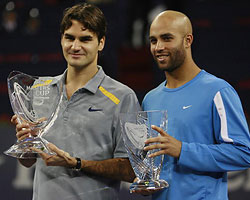
There's something about Roger Federer that makes you want him to break all those seemingly insurmountable records set by other less attractive tennis greats. Perhaps it is his effortless touch on the tennis court which gives him the ability to manufacture a host of breathtakingly impossible shots; or perhaps it his almost balletic grace while moving around the court that enables him to reach every corner of the court before his opponent has even the chance to stand back and admire his 'unreachable' shot; or then perhaps it is his amazing spirit that helps him hit aces when defending break points, and repeatedly at that. Of course, the question that keeps coming back to you over and over again while watching his majestic play with jaw dropped in awe is: how on earth could anyone be so damn good?
In today's Master's Cup final in Shanghai Federer gave only further indication that he is firmly on his way to unforgettable greatness. Not that there has been any lack of signs the past three years. The manner in which he takes apart famed opponents, especially in finals of major tournaments, with alarming ease must definitely rank as one of the greatest spectacles in modern sporting history. And the thing that's most scary about Federer is the fact that he's all of 25 years; one can only pity the long line of unfortunate opponents that are likely to be demolished under the avalanche of his scorching play. James Blake, otherwise an admirably gritty player who has fought his way through plenty of obstacles to reach the elite group of players, could hardly have said anything more frightfully true when he said that 'Roger is the best of the best'. Certainly, Roger is the 'best of the best' of his generation, by a long mile. 9 Grand Slams (and counting), 12 Masters' Shields (and counting, again), 146 consecutive weeks as No. 1 (don't hate me for this, but again, COUNTING) more than stand testimony to the great distance between him and the rest. Whether he is actually the best of all time is a matter best left to talk about at the end of his career, although many have been inclined to give him that label already.
How very unfortunate for me then, that Federer isn't actually my favourite player. No, that place still belongs to the tenacious Lleyton Hewitt, who has very tragically been bogged down with injuries and bad form the last couple of seasons. Yes, I know, Hewitt can't really match the class or ability of Federer, but he did develop into a good player much before Federer did, and I don't change my favourite player just because a scintillating talent blossoms elsewhere. Such disloyalty is not for me. So if Hewitt and Federer ever clash with each other in a match, I'd wholeheartedly root for the Australian, and the very distinct possibility of heartbreak at the end of the match won't dampen my spirit in the slightest. Isn't that a little sad?
That's it for today I guess. My next post will definitely be about something other than sports, so that the sports-haters will not altogether hate my blog. Hope I wasn't too boring today.
Subscribe to:
Posts (Atom)
