Showing posts with label reviews. Show all posts

Saturday, May 24, 2008

When A Treat Is Not A Treat, But Is A Double Treat!

Trust A R Rahman to pull a fast one on us when least expected. For the past 3 years we’ve been fed on crumbs, literally – there have been a measly 3 albums (Rang De Basanti, Guru and Jodhaa Akbar) composed by the musical genius since 2006 and we’ve been forced to sportingly take that lying down. And now out of the blue, two A R Rahman albums releasing one day apart! Talk about a double treat. And even though I know that as a die-hard A R Rahman fan I should be ashamed for not having had a shadow of an inkling that Rahman had been preparing to cut his own album for the past 6 months or so, there’s a certain special charm to pleasant surprises like these. It kind of makes me wish I hadn’t spent the 6 months before the release of the 7th Harry Potter book obsessing about the million or so theories concerning anything and everything about Potterverse.

Right then, so the big question, of course, is – how good are the two new A R Rahman albums – Jaane Tu Ya Jaane Na and Ada? I’ll start with Jaane Tu Ya Jaane Na, or JTYJN for short (I really did think Aamir Khan, of all people, wouldn’t find the need to have the title of his movie sound like the first half of the script). The movie is supposed to be a youthful romance, and Rahman, as always, makes sure that every track in the album perfectly fits the theme of the movie. The first track, Kabhi Kabhi Aditi Zindagi is - there’s no other word for it – vintage A R Rahman. In other words, a very very good composition. Jaane Tu Mera Kya Hai is somewhat a middling track – a little weird on melody, and the kind of song you don’t really know whether to like or not. Nazrein Milaana almost sounds like Shankar-Ehsaan-Loy territory, and I think I should add here that Rahman does a better Shankar-Ehsaan-Loy than anyone else, maybe even better than the trio themselves. I normally hate to use this word, but the track is wonderfully - peppy. So much for the perennial classical inclinations of the maestro.

Pappu Can’t Dance is, plain and simple, disappointing. If there has been one grouse I have held against Rahman these past few years, other than his tendency to occasionally disappear from the music scene for months together, is that he seems to have lost his touch when it comes to dance numbers. Which was the last really rocking dance number you heard from him? Masti Ki Pathshala from Rang De Basanti? When I heard that song for the first time, I had a hard time getting past the fact that the song actually had no tune to speak of. Personally, I thought the Meherbaan track from Tehzeeb was great, but even that was nearly 5 years ago. I don’t know about you, but I really miss the days of Rangeela Re and Humma Humma. But we must make do with what we have, and what we have is still quietly and impressively enthralling. Kahin To Hogi almost sounds like a Westlife/Boyzone track with Hindi lyrics, and it does its job well. And can we ever have a Rahman album without a single track that strays dramatically from the beaten Bollywood path? Tu Bole Main Boloon is laden with heavy jazz and funk elements, and while I’m sure it’d suit the context of the movie well, I can’t really say that I enjoyed the track.

Ok, enough of film talk. Let’s talk about Rahman’s own privately recorded album Ada now. The thing that struck me the moment I started listening to the tracks of the album is how unnatural Rahman’s songs sound when sung by typically dulcet singers like Sonu Nigam and Alka Yagnik. Maybe I don’t notice that in Rahman’s Bollywood albums, but then again, how often does he sign up the typical Bollywood singers anyway? I personally can’t get enough of Rahman’s own vocals – there’s something very endearing about the way he completely disregards the lyrics of the song (he still can’t speak Hindi, even after all these years) and gets lost, almost like a child, in the rhythm and melody of the track. As it turns out, however, there’s just one song sung by him in the album, and that put me off in a big way. Ada is a very nice album, no doubt, but I somehow get the feeling that Rahman is playing it safe with this album – almost too many mass-appealing numbers. Gulfisha is a fantastic track, but what on earth is Gumsum all about? For a second there I almost felt like looking it up on the internet and making sure that it was actually Rahman who’d composed the track and not some blissfully stagnant Nadeem-Shravan or Sajid-Wajid type of music director, what with the Madanpura-style beats and all. Hawa Sun Hawa restored some of my faith in Rahman, and Meherbaan almost made me feel guilty of my earlier disparaging thoughts about him, but Ishq Ada again goes on a tailspin, taking ‘weird melody’ to another level. Hai Dard and Milo Wahan are a little too ordinary for my liking, but Tu Mera Hai is again an impressive piece. I suppose by now I should’ve gotten used to the wild fluctuations in quality that have been the norm with any Rahman album ever since I can remember, but it always comes as a surprise to me that genius must necessarily have its low moments to inspire and propagate its incredible highs.

I think I’m going a little overboard with the whole ‘Rahman and genius’ thing. But you know what, when compared with the run-of-the-mill plagiarists that make up the majority of Bollywood’s musical talent, ‘genius’ might actually be a bit of an understatement. It’s not everyday, after all, that a Taal or a Dil Se is created. To be honest, however, the Rahman magic seems to be waning a little these days – perhaps he needs to take himself a little less seriously? He’s become the mascot, so to speak, of international music, and it just seems to me that he’s become a little too conscious about making sure that his music reflects the global appeal of his work. I think he needs to let go of all the baggage that comes with being a larger-than-life icon and concentrate, instead, on making uncomplicated, beautiful music, the kind of music he made for Roja and Rangeela, the kind of music that made us fall in love with his astonishing – I’m sorry, but there’s no other word for it – genius. No, I have not over-used that word. Some people just deserve to be exaggerated about.

Thursday, February 21, 2008

What's That You've Got Missing? A Heart?


Ok, let me start by saying that I went in to watch Jodhaa-Akbar fully prepared to fall in love with the historical epic. Ashutosh Gowariker, after all, does have a rather splendid body of work to impress and excite people with. You don't get nominated for an Oscar for nothing. And the premise this time seemed so perfectly grandiose - a sweeping love story set in the royally magnificent days of Mughal Shehenshahs and phrases like "Takh Liya!" - what more could one ask for? Everything seemed so right about this movie that, much as in the case of Sanjay Bhansali's Black, people were talking about the Oscar prospects of the movie months before its release. Sadly, they spoke too soon.

I can't really give the exact reason why the movie failed to impress me. The plot construction and character development are more than adequate, the acting is top-notch and the painstaking attention to detail evident throughout the movie is truly commendable. I guess it's just one of those movies which you can brush off with a comment like, "but it had no soul!". And as snobbish as that sounds, I think it's spot on. Gowariker seems to have got a little lost amid all the splendor and the fancy Urdu. The cornerstone of the movie, the fundamentally vulnerable bond between Emperor Akbar and the Rajput princess Jodhaa simply doesn't create an impact as strong as one would have expected in a larger-than-life saga such as this. As contradictory as this may sound, Gowariker had an excellent premise to cut his teeth into, but not enough meat in the central plot to chew on. A cinematic head-scratcher, I'm sure, that not many filmmakers have to deal with.

Historically speaking the movie seems well-researched (for a wikipedia-educated person anyway), though it is certainly questionable whether Akbar would have spent so much time and energy wooing the politically-bonded Jodhaa when he reportedly had over a 100 wives to worry about. The military conquests and political travails of Akbar are intricately woven into the plot in an efficient enough way so that no sub-plot seems out of place or unnecessary. When I say 'sub-plots', of course, I don't include the overly long-drawn sequences of grief and melodrama suffered by just about everyone in the movie, because there sure are plenty of 'unnecessary' instances of those. The movie trundles along at a luxuriously leisurely pace, and while that is forgivable for a period drama, one does wish that Mr. Gowariker hadn't wasted so much time in the first half just trying to establish the proceedings. And the battle scenes. How do I put it? When I first heard about the lavish budget and use of CGI in the film I began to dare to hope that for once, Bollywood would turn out something revolutionary in the purely technical realm of live action. All that came crashing down the moment the Battle of Panipat came on. The sequence is a seriously ridiculous piece of trash, and I was almost in tears by the end of it. Thankfully, however, the quality of the battle scenes improves dramatically as the film moves on (thanks in no small part to the fact that all the subsequent battles aren't really full-fledged, all-out wars but more of small-scale, half-hearted negotiation-cum-conflicts). The final one-on-one fight between Akbar and his principle nemesis bears striking resemblance to the Brad Pitt-Eric Bana fight in Troy, and though it isn't quite as good as the Troy one, it is reasonably well done. The swordfight between Jodhaa and Akbar, however, scores over all the other fight sequences, and considering how much the cinematography and stunt direction of this movie were being talked up, that's a little sad.

The movie's dialogue is considerably difficult to understand, specially since the actors simply refuse to pronounce Urdu the way that it is supposed to be pronounced. And sorry, but there just aren't enough memorable lines for a movie of such epic proportions. The music by A.R. Rahman is fantastic as usual, particularly the Azeem-O-Shaan Shehenshah track, which, in one word, is awesome. As for the acting, I can confidently say that Hrithik Roshan has matured into a truly marvellous actor - he brings out every confused and passionate facet of an emperor with such incredible intensity that I repeatedly had to hit myself on the head for ever having doubted his capabilities as an actor. That said, however, I could never quite shake off the lingering feeling that Hrithik just didn't fit the role of Akbar. He looks - how do I put it? - far too - chiselled? and a little, um, puny, for a king. If you're laughing at me for calling the man with probably the best body in Bollywood 'puny', you ought to take a look at the size of the guy who plays his brother-in-law. Aishwarya Rai is perfectly cast as the headstrong woman-who-would-be-queen, and manages to look like an exquisite dream even when she's straining every nerve trying to make those sobs sound genuine (I have to say I admire her immensely for the effort she puts into acting). The rest are all sidekicks who get sidelined repeatedly during the course of the stuttering romance between these two, though it must be said that Sonu Sood does surprise you with a competent performance.

The cinematography, I'll make no bones about this, is disappointing. The imposing forts and the sets look grand, I'll agree, but I always felt like there was something missing, something that Gowariker forgot to add when taking all those sweeping shots of architectural marvels. There was no majesty in the art direction, no sense of awe-inspiring grandeur. The only times the movie looked anything close to a visual spectacle were when the camera focussed on Ms Rai. This, however, is a completely subjective opinion; I'm sure there are lots of people out there who were totally taken in by the sets and the photography. It's just that I wasn't. It's one of those things. And the movie's length! God, did no one on the sets of the movie remember to carry a watch? 3 hours 45 minutes is WAY too long for ANY kind of movie. One thing's for sure, this film is not going to win any awards for editing.

Gowariker'e last movie, Swades (which I personally loved), was widely criticized for being too much like a documentary and for lacking heart and entertainment value. I think that sort of criticism is much more appropriate for Jodhaa-Akbar. The movie has all the right intentions and the means to be going on with, but it simply fails to ignite the emotions of the viewer. It almost looks a little robotic - some of the lines and sequences, like the one where Akbar abolishes the jizyah tax, come off as downright mechanical. Not a major fault on the part of the director, by any means, but sometimes this sort of thing stops an ambitious and well-made project from becoming a great movie. Swades was a great movie. So was Asoka, if you're talking about historical epics. Not so Jodhaa-Akbar.

Saturday, November 10, 2007

One Time Too Many


We know you like poking fun at Bollywood, Farah Khan, but it's getting a little old now. It all started, of course, with the hysterical Woh Ladki Hai Kahan number from Dil Chahta Hai. Main Hoon Na took Ms Khan's derring-do a step further; the subtlety and the sheer audacity of the humor carried it far beyond the most accomplished Hollywood spoofs in memory and, in my opinion, it can now be bracketed among the masterpieces of the decade. Yes, it's worked before, but that doesn't mean it will work every time. Om Shanti Om, Farah Khan's latest offering, is everything that a typical Diwali blockbuster ought to be, and yet it's remarkably unsatisfying, almost as though she had all the right intentions and cinematic techniques in mind but forgot somewhere during the making that she was making a full-length Bollywood movie, not an MTV gag show.

Om Shanti Om is as extravagant as they get - the huge sets, colourful songs and charismatic stars are all dutifully in place, as are the melodramatic lines and intentional over-acting. The plot is ludicrously fantastical - an unabashed mixture of Madhumati and Karz, if you will. Shahrukh Khan hams like there's no tomorrow, Kirron Kher weeps buckets as the quintessential tragic mother and there's also a disarmingly gorgeous newcomer in the form of Deepika Padukone to keep things electrified. In short, everything that made Main Hoon Na such a delightful charmer is recreated in this nearly 3-hour long saga. If only Om Shanti Om was half as entertaining as its predecessor. I'm sorry, but Farah Khan has some major explaining to do as to why exactly the first half is as boring as it is. The 70's may have been a fascinating time in the Bollywood studios, but Ms Khan's depiction of the same is decidedly not. Forget the tongue-in-cheek potshots at melodrama, lovers playing lousy tennis and garish costumes - if it doesn't keep you entertained, it's all a waste of time.

The second half is considerably better, and thankfully moves at a lively pace, but again you always get the nagging feeling that something's missing. The almost non-stop sprinkling of stars in funny cameos does manage to perk things up appreciably, but things go flat the moment the movie comes back to the central plot. For some reason, the movie decides to take itself more seriously as it approaches the climax, with expectedly disappointing results. A Madhumati-inspired culmination wasn't exactly the brightest idea, and the end credits, with every single crew member getting to dance absurdly for the cameras, is downright annoying. An overdose of MTV, perhaps?

The songs, for once, DON'T slow down the pace of the movie (surprise, surprise!), and that's mainly because all of the songs have a definite purpose and carry the story forward (with the exception of Deewangi Deewangi - but then again, weren't the "31 stars" the biggest attraction of the movie?). Moreover, the fact that Farah Khan is a choreographer par excellence is a major plus point too. Main Agar Kahoon has to be one of the best shot songs in recent times - one of Farah Khan's finest works ever. Dard-e-Disco is a bit of an eyesore, but the rest of the songs are fairly tolerable, and coming from a sworn song-hater (only in the middle of a movie) like me, that's gigantic praise. You've got at least one department of Bollywood filmmaking completely covered, Ms Khan.

Comparing a director's product with his earlier works isn't always the fairest thing to do. However, when the director decides to repeat or even refine his earlier methods, then comparisons are justified and more importantly, inevitable. And I can confidently say that Om Shanti Om's biggest drawback is that its director is the maker of a gem like Main Hoon Na. While Main Hoon Na was fresh in its appeal and made you laugh hysterically, Om Shanti Om looks repititive and only manages to make you chuckle, and that too sporadically. Again, while Main Hoon Na had a concrete, if laughably unrealistic script (as intended), Om Shanti Om suffers from jerky writing and an excess of needless subplots. And of course, someone needs to tell Ms Khan that the whole spoof-cum-tribute thing looked cute the first time; the second time it only comes off as stale and unimaginative. Please, Farah Khan, get down to some serious filmmaking next time; brand SRK can only save you so many times.

P.S. All of these disparaging comments about Om Shanti Om have stemmed mainly from the fact that I absolutely loved Main Hoon Na. If you haven't watched or worse still, absolutely hated Main Hoon Na, then the chances are that you might just thoroughly enjoy Om Shanti Om.

P.P.S. Deepika Padukone might just be the next big thing of Bollywood. If only she had a remotely pleasant voice to go with her stunning looks (and this is assuming that her voice wasn't dubbed for the movie).

P.P.P.S. Akshay Kumar is positively hilarious in his two-minute role. The movie might actually be worth watching just for his brilliant turn.

Saturday, October 27, 2007

The Good Side Of Bollywood


I'd almost forgotten how it felt to watch a clean, wholesome and thoroughly entertaining Bollywood movie. Now don't roll your eyes at me as though I'm some Hollywood-crazy wannabe. Bollywood actually has been churning out some pretty insufferable stuff of late; you can't blame me for fawning over every new Hollywood release while only coldly condescending to declare to anyone who'd listen that I have no time for the melodramatic trash that is churned out by Indian filmmakers. But every situation has a saviour, as they say, and I can confidently say that I have found, if only accidentally, the perfect balm to my Bollywood-aversion - the deliciously charming Jab We Met.

To put it very simply, the movie is a top-class entertainer. If Socha Na Tha, director Imtiaz Ali's first venture was a refreshing take on the quintessential Bollywood love story, then Jab We Met is more of the same, only considerably funnier. The plot, admittedly, is nothing much to write home about - there can be only so many variations of the boy-and-girl-meet-on-a-train-and-decide-to-embark-on-a-life-changing-journey-together pitch. Ali's execution of the trite, formulaic story, however, seems something like the wave of a magic wand - all of a sudden the situations seem more realistic, the characters more likable and the journey more fascinating. The dialogues are witty, the visuals stunningly dreamy (just why haven't our filmmakers explored Manali to the fullest?) and the melodrama is kept to a bare minimum. Did someone talk about the definitive Bollywood romantic comedy?

There are many things wonderfully close to perfection about Jab We Met, but none as close as the casting. Kareena Kapoor was born for the role of Geet, the high-strung Punjabi who lives life in its most dangerous and intoxicating fullness, and every single scene in the movie screams this simple fact loud and clear. For someone as prone to over-acting as her, Kareena shows remarkable restraint and poise, and some credit for this must definitely go to Ali. This girl clearly has oodles of talent; why do so few directors make full use of it? As she sprints across the railway station, completely out of breath, screaming, "Besharam, apni wardi utar ke phek de", you know you're watching a potential legend. Shahid Kapoor, though overshadowed by the sheer charisma of his co-star, puts in a thoroughly accomplished performance. The music is melodious and the choreography of the songs is breath-taking; however, you can't help but notice that the songs do more harm than good: slowing down the pace of the movie is NOT a good idea. But I can forgive one blemish in a movie which is otherwise so thoroughly entertaining.

The movie has a certain subtlety to it that transcends the loud Geet and her louder family. It has no sermonizing and no unnecessary tears, yet the difference between living one's life impetuously and taking life too seriously is brought out with mesmerizing vividness. The movie has one of the most heart-warming separation lines in the history of Indian cinema and it can also boast, quite unusually for a movie of this genre, of a brilliantly taut climax. Is this the best Bollywood romantic comedy ever? Ah, looks like I'm going a little overboard now. Blame it on the excitability of human nature. Or on the incredible star appeal of a certain Kareena Kapoor. Don't sneer, watch the movie.

Sunday, August 19, 2007

Cheesy Gets Fun


What is it with Steven Spielberg and aliens? Just about every significant movie about aliens, weird creatures or supersmart/monstrous/robotic freaks of nature in the past decade (and maybe even the decade before that) has had some connection with the legendary filmmaker. Which is not to say that he's always been brilliant at the gory extra-terrestrial dramas. War of the Worlds was a positively dull (and incomprehensible) CGI-reeking mess, while Men In Black had a tad too many gooey/slimy/disgusting creatures for my liking. The fact remains, however, that Spielberg loves extra-terrestrials. Which is why it is not surprising that the man has a firm connection with the big movie with even bigger aliens, Transformers, as its executive producer. Of course, Michael Bay is the captain of the ship here, and though it was totally expected of him to continue with his tried-and-tested formula of making thrill-a-minute entertainers with no depth whatsoever, I thought Spielberg's involvement would have made some difference here. Well, I was wrong - Transformers is as mindlessly entertaining and frivolous as Hollywood could ever get. And hey, I'm not exactly complaining. It's alright if filmmakers go for the Star Wars/Spider-man effect for their blockbusters at times; we don't expect a Batman Begins every single time. And even if we did, we wouldn't really be granted our wish, would we?

The visual effects in Transformers are, to say the very least, stunning. The level of detail and sophistication, together with the scale and magnitude of the cinematography makes 300 look amateurish in comparison. One just wishes, however, that they'd slowed down the camera in some of the fight sequences - it's almost impossible to keep up with the lightning pace of the transformations and stunts. On the flip side, the plot of the movie is about as ridiculous as Roger Federer losing to Guillermo Canas twice in a row. I don't know about you, but the whole 'allspark-code-grandpa glasses' angle almost made me burst out with laughter. But the thing that really had me in splits was the line "I AM MEGATRON!!!" - not exactly the first words you'd expect to hear from a robo-alien that has been defrosted after a hundred years. Nevertheless, the flick was great entertainment - the over-the-top theatrics (especially the unfathomable attachment that the lead characters feel for the far-from-lovable robots), the melodramatic humour and the ultra-cool Megatron (aside from his ludicrous opening line) bring more than a few smiles to your face. You almost want to forgive the childish dialogue and lack of depth in the plot and characterizations. Transformers is immensely likable, and is one of those rare movies that you can watch any number of times without getting bored. So three cheers to frivolous cinema!

Sunday, July 15, 2007

A Week Before D-Day, and Things Have Turned A Little Sour


Here's an unusual question for Harry Potter fans: Is watching the latest Potter movie the best preparation for reading the newest Potter book? The guys up at Warner Bros must obviously have felt that the answer to that question is yes, a feeling that will most likely be vindicated by the bumper box office returns Harry Potter and the Order of the Phoenix is bound to get. On the flip side, of course, Deathly Hallows is releasing on the 21st of this month, almost exactly one week after the opening of Phoenix, and heaven help Warner Bros if they think Potter fans are going to spare even a sideways glance for Harry's frustrating struggles with Dolores Umbridge when they could instead be grappling with monumental things like Snape being evil after all or horror of horrors, Harry himself going out with a painful death. But that's not the only problem the movie faces. I hate to admit this, but Phoenix suffers greatly from a tad too many over-creative liberties taken by the director David Yates, who perhaps needs to be told by someone that you just cannot fit an 800-page long book into a 2 hr 20 min short movie. Math, anyone?

The best that can be said about OOTP (Order of the Phoenix, for the uninformed) is that it is better than the first two Potter movies. The movie satisfies the hardcore Potter fans in managing to squeeze in nearly every important event from the book, but sadly, that very intent makes many of the scenes look rushed and fleeting. As for the changes from the book, well, let's just say that Yates should have had a serious chat with Alfonso Cuaron (the director of Prisoner of Azkaban) or even Peter Jackson, for that matter, about the do's and dont's of bringing new plot details in a hugely popular book before even thinking of directing the movie. Most of the changes in OOTP seem forced and unnecessary, and it only my fear of being labelled a raving/lunatic/obsessed Potter freak that's stopping me from listing all of those disagreeable changes here. Many sequences in the movie have an unfinished, anti-climactic feel about them (note the vapid end to the scene where Trelawney is sacked or the irritatingly docile reactions of Ron and Hermione to Umbridge's torture tactics). Sirius's death is butchered mercilessly, and Harry's outburst in Dumbledore's office, one of the most poignant episodes in the books, never comes to pass. Bellatrix Lestrange looks like a deranged medieval witch most of the times, and Grawp the Giant looks cute rather than scary. Ok, maybe I am sounding like a raving/lunatic/obsessed Potter freak after all, but who cares?

The special effects are fairly satisfactory, but the acting from the Trio is not. Alright, I'll leave out Rupert Grint from this - he's been consistently decent right from the first movie; but will someone please tell Daniel Radcliffe that he needs to put something on his face, like say, expressions? Emma Watson looks all pretty and charming (which Hermione is NOT supposed to be), but would definitely make things a lot more tolerable for everyone if she just stopped making her eyebrows continually dance like they're preparing for a ballet, or even if she refrained from delivering EVERY line looking like she's terribly out of breath. The older actors, on the other hand, put in very good performances, particularly Jason Isaacs, who as the pure evil/subservient Lucius Malfoy steals the show from everyone (including Gary Oldman in another appropriate Sirius Black turn). Imelda Staunton as Umbridge is almost perfect, specially with the 'Hem, hem' rendition and the revolting girlish wickedness, and there could not have been a better choice to play Luna Lovegood than Evanna Lynch. However, my biggest grouse with the Potter movies remains the shoddy portrayal of perhaps the third most important character in the books, Severus Snape. Alan Rickman may be a fine actor, but it is simply unacceptable that the makers have chosen to reduce Snape to a bumbling, comical idiot whose most significant moment is hitting Ron with a book. It's amazing how I seem to be the only one who finds fault with Snape's portrayal in the movies, but J K Rowling had always intended for Snape to be a no-nonsense, vicious, supremely smug persona, and the movie Snape is anything but that. I seriously cannot understand how they're going to undo all the damage they've done to Snape's character when he comes into its own in Book 6, the title of which, funnily enough, is named after him. In my book, Isaacs would have actually done a marvellous job as Snape, but will anyone listen to the true Potter fan?

The one thing that can be said about OOTP is that it hardly ever gets boring (ok, maybe the first half is a little boring, but you can't really blame Yates for that - nothing much happens in the first half of the book either). It would've been all perfectly good fun if it wasn't for the inescapable fact that it is an adaptation of a Harry Potter book, which naturally makes us pick at and frown at every minor detail which is inconsistent with the spirit of the book. It would also have helped greatly if they'd taken the trouble to explain everything about the plot adequately enough (my non-Potterized friends kept breaking out into perfectly understandable questions like, "what the hell is going on?"). And while we're talking about explaining things, I shudder to think how they're going to do that in Movie 6 with things as complex as Horcruxes flying around, specially if they're going to be hell-bent on sacrificing justice to the books for cash-generating ploys like keeping the length short. Alfonso Cuaron, where art thou?

Monday, May 7, 2007

A Slow-Paced, Boring, Melodramatic Must-See


An alien symbiotic creature that clings to a piece of clothing, a man with a curious ability to conjure and resize his clothes entirely from sand but who wilts when exposed to water and a fully grown superhero weeping like a two-year-old when his girlfriend dumps him. 'Spiderman' was never about being realistic anyway. And with Spiderman 3, the improbability stakes go up just that bit higher. But who's complaining, when the stunning action scenes, breathtaking cinematography and lightning pace keep the audience obscenely entertained, right? The trouble is, Spiderman 3, for all its action-packed thrills and feeble attempts at philosophy, just cannot keep you glued to your seats - it is, quite simply, boring. And for a series as record-breaking and amusingly awe-inspiring as Spiderman, that's not good news at all.

The movie attempts to deconstruct the psychology of superheroes (now isn't that a Herculean task!) and underline the most basic doctrine of all - being bad is fun. The old guard of Tobey McGuire, Kirsten Dunst, James Franco and Rosemary Harris reprise their roles as the central Spiderman characters in this mildly dark and very slow-paced affair. The movie starts off with Peter Parker (McGuire) and Mary Jane (Dunst) firmly ensconced in a compromising yet carefree romance, who spend their time together entangled in gigantic spider webs. Parker is still without a permanent job, but this time, MJ joins him on the list of the unemployed after being kicked out of a ridiculously dull stage performance the like of which I'm pretty sure will not find a single a viewer in the real world. The relationship begins showing signs of strain, what with Spiderman being such a hero and all and poor Miss MJ being reduced to working as a singing waitress. Things take a turn for the worse for the cranky couple with the appearance of the shockingly unimportant Gwen Stacy (Bryce Dallas Howard, utterly wasted) and her snotty boyfriend Eddie Brock (Topher Grace). For some reason, Spiderman thinks it a good idea to share a passionate kiss with Gwen in the presence of a shell-shocked MJ, which makes one wonder whether Spiderman is inherently evil after all, Venom or no Venom.

Meanwhile, Flint Marko (Thomas Haden Church), a predictably wronged convict on the run from the police, gets transformed into the invincible Sand Man under highly mysterious, not to mention amusing, circumstances. The script's excuse is that a 'particle physics' laboratory carries out highly dangerous, 'demolecularizing' experiments in frightfully unguarded pits, under the open skies, with not a hint of a worry about any thing or being falling into the pit accidentally and getting its molecules ripped apart. So Flint Marko, now Sand Man, comes to be a pretty invulnerable monster who is furious at the world for some reason, but who also has a human side to him, compassionately trying to rob every bank in sight to gather funds for treating his daughter's incurable illness (no idea what the illness is). All this while, the alien 'Venom' stealthily sizes up the emotionally ploughed Parker, waiting for the right moment to cling inseparably to the noble superhero and turn him into an arrogant, aggressive demon. And wait, there's another crucial subplot - Harry Osborn is finally ready to take up his due post as the new Green Goblin or the Hob Goblin (the name fans of the comic will assure you is the correct one) and avenge his father's death. A bout of amnesia for this one considerably eases things for poor Spidey, who has his hands quite full with not one but five different adversaries (MJ can be counted as an adversary too - she barely looks at him with anything other than pitying disdain during the movie). A case of too many villains? Fans of Spiderman the comic will wholeheartedly agree.

The film has plenty of moments to savour - the action scenes are brilliant as usual, and the fight sequence between Peter and Harry, (not the one between Spidey and Goblin) is fantastic, with the underlying simmering tension and deep-seated affection between the two spilling over quite dramatically. The episode where Spidey willingly gives up his sickeningly saccharine self in favor of the evil yet cool alter ego guided by Venom's venomous ways has been handled with wonderful deftness. You can actually feel Parker's enjoyment at being allowed to be bad, and McGuire, it has to be said, does a thoroughly efficient job in these parts. The character development is really shoddy though - there doesn't really seem to be any point to the Sand Man character, and Venom is quite unceremoniously dumped to the sidelines by all the romance and irritating sequences concerning the murder of Parker's uncle (turns out he was killed by Sand Man after all). Gwen Stacy is laughably insignificant - it seems the makers intended to give her a full-blown role at the beginning but forgot all about her somewhere in the middle. Nothing else can explain why they chose an actress as brilliant as Howard for the part, or why she accepted it.

The dialogues are predictably trite, but that's completely forgivable in a Spiderman flick. The acting is fairly average, though one wishes McGuire would tighten up his act in the emotional scenes - all he had to do was look at Dunst, who undoubtedly is the best performer in the movie, even if her character is horribly annoying. James Franco and Topher Grace do adequate jobs, and Rosemary Harris, thankfully, has very little to do in this one, because there's only so much of Aunt May reminiscing about her poor old husband and their lame times together that one can tolerate.

The romance is overbearing, the action too little, the pace too slow and the storyline too hackneyed and melodramatic. And yet, Spiderman 3 deserves to be watched at least once - the 'evil is fun' theme is far too irresistible, and the movie's box office returns are far too humongous to be ignored. There are many movies that are deserving contenders to qualify as the definitive movie of our generation, but none as strong as the Spiderman series. This is Hollywood at its costliest, loudest and most extravagant - let yourself be overawed by the hype, it's fun. Even if it is boring.

Wednesday, March 21, 2007

A Real Laugh Riot


What do you do when you go out to watch a movie expecting it to be something of an epic cross between Gladiator and Troy, at least in terms of class, and instead get an apology of a movie that alternates between downright hilarious and painfully taxing? Curse the voters at www.imdb.com, that's what. I know the ratings system at the "earth's biggest movie database" can be a little quirky at times, but a rating of 8.2 for something as crass as 300, spearing it into the list of the top 250 movies of all time is pure scandalous. And the movie's making all the big bucks too - having scythed a rollicking opening in the US, it's on its way to becoming one of the most successful war movies ever. Seriously, Hollywood needs to be rescued, and fast.

The problem with 300 is not so much its actual quality but its over-ambitious intent. All the makers had to do was make a big budget, visually attractive movie that did NOT pretend to be anything more than a regulation comic book adaptation. Instead, they chose to aim for Lord of the Rings-style glory, which, predictably enough, makes it laughably over-dramatized. And don't even get me started on the liberal helpings of gore and violence, which, coupled with the noir-like brown tinge present throughout like some kind of sympathetic haze, gives you a right splitting headache. 

The film starts off dreadfully, with some kind of barbaric ritual meant to give superpowers to the privileged citizens of Sparta that only makes you fear for the sanity of the incredibly hot-headed Spartans. And things don't get better from there; in fact, they get progressively worse. The focus shifts to a blood-thirsty king who foolishly challenges the mighty Persian army to battle the specially-designed Spartan warriors. There's a queen too, who perpetually seems to be itching to deliver some powerful lines. Cut to a scene showing a savage bunch of morally-challenged priests and a very apoplectic Oracle-girl, and the king is advised not to go to battle. If only the king had heeded the good priests' advice, we would have been spared some really wasteful shots that are filled with nothing but blood and severed heads.

Instead, the king sets out to pulverize the almost-invincible Persian army with a puny band of 300 people, because he can't engage in full-scale battle. And here's where the real comedy starts. There are so many problems with this crazy suicide warring that it seems amazing that the legend of this ludicrously impossible episode has lasted so long. The 300 warriors, all of whose profession is apparently 'Hoo hoo hoo!' (at least, that's what it sounded like) go forth with no bodily armor, and indeed, practically no bodily clothes either. 

They then embark on a series of loud yells and excited pronouncements of the word 'Spartan!'. In fact, the words 'Sparta' and 'Spartan' are used so often in the movie that towards the end I was tempted to keep count. Everyone mentions one of these two words in nearly every line - the king continually insists that they should all die for Sparta, the warriors keep chanting that Sparta stands for freedom, and even the queen addresses her husband, not as 'my dear', 'my lord' or even by his name, but as, you guessed it, 'Spartan'. Clearly, the makers have a passionate obsession with all things Spartan.

The appearance of horrendously mutated and unpleasantly disfigured humans and all sorts of other creatures is something of a fashion in the movie. And some of the shots showing exactly how the 300 warriors enthusiastically butcher all of their adversaries, in very graphic terms, are too gruesome to describe. I still can't get one shot, where the king stabs the eye of a particularly nasty human-demon, out of my head - it was that grisly. Meanwhile, the king's ear-splitting yells and incessant spitting-in-the-face antics seem constantly in danger of driving his followers into raging madness. Instead, they get more violent by the minute, choosing to break into demented laughs every time they seem likely to be overrun. 

The Persian king Xerxes, looking very much like a vengeful bride and adorned with nearly ten kg of jewelery, makes some exuberant appearances too, and in fact, his sequences are among the funniest of the movie. Eventually, after an exasperating sub-plot involving the queen who is deceived with astonishing ease by a lecherous Councilor, the movie draws to a close, with the Spartans in exactly the same position that they were in at the start of the movie: on the verge of going to war with the Persians. Talk about a pointless plot.

The acting is bad, the dialogues embarrassingly childish, and the central idea of the importance of freedom is lost amidst the gallons of blood. The only area where the movie scores is the cinematography: the visuals are truly spectacular, and the graphic detail has to be seen to be believed, though that's one of the main reasons why it turns out to be so horrifyingly macabre. 300 is, quite simply, a disaster. But hey, if you can stand the gore and violence, you should definitely go for it: it will give you some really good laughs. And if you want to make your experience really memorable, watch it with around 10 of your friends; the comments will never stop. 

If only there wasn't the small matter of a hundred bucks being spent entirely on joking around with your friends; normally, joking around comes free.

Tuesday, March 6, 2007

Ultimate Classic Not So Classy


How do you prepare yourself to watch a movie that many consider to be the greatest of all time? Don't read the book that the movie was adapted from, for starters. And definitely don't raise your expectations so high that you anticipate a Steven Spielberg movie to look something like a cross between Dhoom 2 and Fanaa in your forever-enlightened future. Sadly, I didn't follow any of these two sacrosanct commandments before watching the supposed ultimate classic Gone With The Wind. This may sound shocking to many, but I didn't really think the movie was any great shakes. And considering the fact that Victor Fleming, the director, was also the man behind The Wizard of Oz, my unhappiness with Gone With The Wind puts my plans of watching all the movies of 'Hollywood's Golden Age' in serious jeopardy.

The real trouble with the movie, I thought, was the fact that the book written by Margaret Mitchell was simply magnificent. Scarlett O Hara was, and will remain, the most consistent, charming, enigmatic and electrifying character ever created. It would have been humanly impossible to portray all the facets of the character on screen convincingly enough, which is precisely why I thought Vivian Leigh doesn't do justice to Scarlett, and this, may I add, would have been the fate of any other actress who would've attempted the role. Very often, the screen Scarlett comes off as nothing more than a silly little bimbette, and while Scarlett was supposed to be a 'spoilt child', she was always a very smart spoilt child. Leigh certainly looks as bewitchingly beautiful as anyone could have imagined Scarlett to be, but towards the end of the movie, with every 'Ohhhh Aaashleeeyyy' in that exasperatingly overstrained tone of hers I was increasingly wishing for 'Aaashleeeyyy' to turn around and give her a resounding thwack on the head. There are moments when Leigh manages to do brilliantly, like the scene when she learns of her father's senility or the one with Ashley's birthday party, but those are quite evenly balanced by her unsatisfactory acting in the 'God is my witness' outburst or the botched up climax.

There are faults in the direction too; Scarlett's Herculean struggles after returning from Atlanta just aren't depicted adequately enough, nor is the undefinable change that comes in her after her episode with Ashley at Tara that steels her enough to make a fortune out of enslaving convicts. I could accept the scriptwriter leaving out Scarlett's first two children from the movie - they were hardly important to the story; but giving Will Benteen, a significant part of Scarlett's evolvement a complete miss was very nearly a critical mistake. Alright, I know the movie is already nearly four hours long, but that's the problem with reading the book first: you just cannot forgive certain deficiencies in the movie, no matter how reasonable they may be. The climax, save for the legendary 'Frankly, my dear, I don't give a damn' line by Clark Gable is highly disappointing. And speaking of Clark Gable, I can't really believe that he didn't win an Oscar for his performance. I simply cannot imagine anyone other than Gable in the role - he is, there's no other way to say it, stunningly perfect. So is Olivia de Havilland as the unbelievably sweet Melanie. In fact, the two people that did win Oscars for acting from the movie, Vivian Leigh and Hattie McDaniel (as the irrepressible Mammy) aren't really the best performers in the movie. Leslie Howard as the whimsical intellectual Ashley is really good too, but failed to get even a nomination. Ah well, I suppose you can't really argue enough about the strange ways of Oscar juries.

A movie adapted from a book will always be a little iffy; there'll always be legions who completely despise the movie even if it is a cinematic masterpiece. While I certainly don't despise the movie version of Gone With The Wind, I do believe it could've been better. And since I haven't watched any of the Godfather movies yet, my opinion that the Lord of the Rings trilogy is the only instance where the movie adaptation turned out better than the book (for the record, I found J R R Tolkien's epic tremendously boring) remains unchanged. So I wouldn't mind Hollwyood doing a remake of Gone With The Wind, with perhaps Kate Winslet and Hugh Jackman in the lead (though I suppose it would be really difficult to show Winslet as a 16-year-old village belle). OK, I know what I just said may seem outrageously scandalous to most people (since, for the uninformed, most people worship Gone With The Wind as the greatest thing that ever happened to a trashy thing like Hollywood), so I think I'll wind things up here. And hope against hope that Godfather, which I'm going to watch tomorrow, doesn't turn out as disappointing as Gone With The Wind. Alright alright, stop thinking about the rotten tomatoes now. There's no way they can come through a computer screen.

Saturday, November 25, 2006

The Failure Of 'Formula'


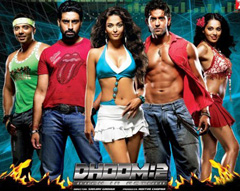
Dhoom 2 is probably the safest movie that has ever been produced in Bollywood. The original was an iconic blockbuster; the genre and special effects have always had a devoted fan-base; and the movie boasts of big names like Aishwarya Rai, Hrithik Roshan, Abhishek Bachchan and Bipasha Basu. As if all this weren't enough, there is the small matter of the maker being Aditya Chopra, who knows the pulse of the audience probably as well as the number of movies he has directed (for the uninformed, this one is directed by Sanjay Gadhvi). The hype leading into the movie was unbelievably immense-there must hardly be a single person in the country who hadn't discussed the super-slick theatrical promo that was shown two months ago with visible excitement (and perhaps a bit of drooling as well). Seriously, how could anything possibly go wrong with such a sureshot blockbuster?

Sadly, however, things do go wrong. The movie just isn't the ultra-stylish, jaw-dropping thriller that it promised to be. If anything, the direction of the movie looks almost indifferent, as though the makers knew that no matter what kind of trash they hurled at the audience, it would be lapped up because, well, because it was 'Dhoom 2'. Not that the movie is absolute trash. But with the kind of anticipation and hype surrounding it, it is definitely one of the most disappointing movies of the year.

The movie starts off predictably, with a heist executed by the super-suave thief (Hrithik Roshan) that the director had probably intended to appear breathtaking but only comes off as a Mithun-style walkover. The makeup of the 'Queen' (is she the Queen of England? Why on earth is she traveling by a train?) is especially bad, and one could be forgiven for imagining that it was actually Hrithik in disguise all along (which it isn't). The story then moves to Abhishek Bachchan and his somewhat funny sidekick Uday Chopra, who are joined by the sultry Bipasha Basu in trying to nab the mysterious Mr. A (Hrithik, if you hadn't guessed already). The movie then stumbles from one slick heist to another (again, 'slick' only to the extent of the director's intentions-to an audience which has been fed on a constant diet of movies like 'Ocean's Eleven' and 'The Italian Job', most of Hrithik's daredevilry seems like amateur stuff). Of course, as in all Bollywood masala movies, there is a steady stream of songs strewn among the proceedings, and after an hour or so of trundling along, one begins to pray for Aishwarya Rai's entrance. Her opening sequence, however, is again shoddily done, and the movie reaches one of its many low points when Hrithik and Ash engage in a game that is supposedly basketball. Okay Mr. Gadhvi, we know neither Hrithik nor Aishwarya can play half-decent basketball, but did you have to make it so obvious?

The second half is mercifully a lot better than the first, though since the first half is positively tawdry, that isn't saying much. Ms Rai is now Hrithik's partner, and the action moves to Rio de Janeiro for no apparent reason other than the opportunity to do some deft camerawork in a beautiful location. Enter Bipasha's twin sister who has as much meat to her role as a a pure veg Gujarati thali. Uday Chopra's by-now predictable love-sickness occupies much footage in the second half, and irritatingly so. The Hrithik-Ash sequences, on the other hand, have been shot rather well, and their chemistry together is fantastic. Wish one could say the same about the ridiculous climax and the unbelievable stunts performed by the admirable trio of Abhishek, Hrithik and Uday.

Performance-wise, it is Hrithik Roshan who steals the show, towering over the movie with his enigmatic screen presence and efficient acting. Abhishek Bachchan gets completely over-shadowed in the sequences between him and Hrithik, but is fairly proficient otherwise. Bipasha Basu has nothng much to do other than look alluring and dance insignificantly in the background. Uday Chopra takes off from where he left in the original, which means that if you hated him in the original, you're sure going to hate him here as well. And that brings us to Aishwarya Rai. The former Miss World, in her completely new get-up, looks stunning with a capital S, and is bound to raise a few eyebrows with a few unusual sequences. She emotes well too, which is precisely why her scenes with Hrithik are the high points of the film.
Perhaps the biggest problem with Dhoom 2 is that there are too many big stars in it. In trying to give every one of the actors a fair share of the footage, the director loses the essence of the main plot. The charm of the original was in the novelty of its concept and the simplicity of its execution. Here, however, the director tries to create a larger-than-life impact in every single frame, and that only makes every piece of dramatic background music and every polished slo-mo sequence a bit of a painful experience.

The story at the box-office, however, might just turn out to be all gold and glitter, and that is because Dhoom 2 is tailor-made for the masses. The stunts and drama may be difficult to digest for the 'multiplex crowd', but are bound to be loved by the rest of the crowd. And I hate to admit this, but the movie never gets boring or dull at any point of time. Low quality cinema this may be, but the fast pace and big names ensure that you remain glued to your seats for the considerable length of the movie. However, if you really want to watch a quality thriller, I suggest you go and watch 'Don' again.

Wednesday, November 22, 2006

The Wizard Does It Again


The 18th of November. The day to experience musical bliss - the date of release of the music of 'Guru', the latest Mani Ratnam offering with A R Rahman as the music director. The combination of Ratnam and Rahman has, of course, produced musical masterpieces of the finest quality in the past, not least irresistible of which was 'Dil Se' and the magical 'Chaiyya Chaiyya' number. Add to that the fact that I simply LOVE anything and everything created by Rahman, and you'd get a fairly good idea of how excited I was for the 18th of November to arrive.

Arrive it did, and after a lot of frantic hunting and searching I finally got my hands on the seven prized tracks of the movie. And though I was pretty confident that I would not be disappointed with the jackpot, considering Rahman's outstanding tendency to repeatedly come up with stunning music, after hearing the songs my first reaction was - 'Better than Rang De Basanti. Now don't get me wrong, I am actually very fond of RDB's music, but I always felt that the focus of Rahman's efforts in RDB was to make songs that suited the movie and carried the story forward. They did do that brilliantly, but the niggling feeling that the music of the movie in its individual sense wasn't of the very high quality that is expected of Rahman in a big movie such as RDB never quite left me. With Guru, however, it is a different story altogether. Perhaps it's the Mani Ratnam influence at work, but Rahman crafts a thoroughly assured album this time, with all the versatility and unpredictability that has become so expected of his music.

'Tere Bina' and 'Aye Hairathe' are two wonderfully similar and wonderfully soothing numbers, and have a distinctive sufi style to them, a brand of music that Rahman had perfected so long ago in 'Taal' and 'Fiza'. 'Barso Re', on the other hand, is a very boisterous track that is sung brilliantly by the extremely talented Shreya Ghosal, and I need hardly mention that this is a winner of a track too. 'Mayya Mayya', sung by a singer with a singularly Arabian feel to her voice (I forget the name of the singer-Rahman does have a very irritating habit of pickng up completely unknown and unheard of singers from nowhere) is very well-composed for the most part but loses steam (and a little rhythm too) towards the end. Somehow, the Gujarati elements interspersed among the heavily Arabian flavour present throughout the song don't strike the right chord.

'Jaage Hain' is a very slow, soft track that will seemingly create a greater impact when heard during the movie. The two situational tracks in the album, however, stick out horribly, but this is no real shock because Rahman does have a tendency to range from the supremely sublime to the intolerably trashy, even within a single album. 'Ek Lo Ek Muft', in particular, is very probably one of his worst songs ever, and Bappi Lahiri's vocals do nothing whatsoever to induce any liking for the song. It just sounds bad, period. 'Baazi Laga', meanwhile, is quite an insipid composition, and hardly compares with the 'Chori Pe Chori' track from Saathiya from which it draws inspiration. However, the rest of the tracks in the album are so exceptionally good that the two shoddy numbers can hardly make a dent in the impact created by the album. And the impact, it must be said, is very very strong-I can say without hesitation that this is one of Rahman's finer albums, and is definitely better than the previous collaboration between Ratnam and Rahman, Yuva.

What is it that makes Rahman click, over and over again? His incandescent genius has been on show for nearly fifteen years in Bollywood now, and perhaps much longer in the South. And yet, he manages to surprise you with a remarkable new sound nearly every single time he creates an album. Perhaps his greatest skill is the amazing ease with which he transcends the boundaries of Bollywood to come up with truly global music that at the same time gels wonderfully well with Indian movies and sensibilities. And his music hasn't always been of the arty kind that only appeals to the intellectual elite. Indeed, he is one of the few musicians who have been able to effortlessly glide between the classical and the blockbuster and whet the appetite of the classes as well as the masses with astounding aplomb. Some of the music he has created, like for instance Taal or Lagaan is so striking that it leaves you wondering why and how he is still employing his phenomenal gifts in a place as loud and trashy as Bollywood. Quite frankly, I don't think Bollywood deserves an extraordinary genuis like A R Rahman.

Monday, November 20, 2006

Blonde Bond Is Bland


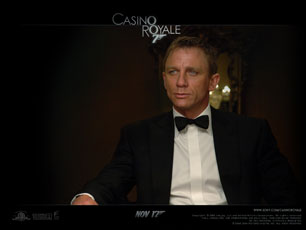
The unnaturally high media interest and hype that surrounds the James Bond franchise has always seemed a little puzzling to me, considering the fact that none of the instalments of the series have actually been historic blockbusters. Perhaps it is the tendency of the British media (and not just the tabloid one) to sensationalize every little insignificant move made by any Briton who is 'somebody' that is the cause of this aberration. The frenzied speculation among the headline-happy media about the identity of the new James Bond had, however, been silenced to widespread disappointment when Sony unveiled the little-known Daniel Craig as the latest spy with a licence to kill. Craig's apparent lack of charisma and a somewhat colourless persona had been a source of much anguish for Bond fans who were soon fervently wishing that Pierce Brosnan had never left the franchise. The reasonable ones among the legions of Bond fans were more guarded in their reactions and were content to adopt a 'let us see' attitude to the sordid affair. And now that 'Casino Royale', the centre of the entire debate, is out in the open, does the hype justify the actual product? Is Craig cut out to be the suave spy? Or did Sony make the stupidest blunder in the history of 007 filmmaking by dropping a successful Bond for a less-than-adequate replacement? Having watched the movie today, I can only say that Sony made mistakes not just in the casting department, but in the entire making of the movie.

Casino Royale is not so much a hi-tech, jaw-dropping follow-up to Die Another Day as it is a throwback to the brawny Bond movies of old. For one thing, there are hardly any hi-fi gadgets or irresistible gizmos to help Mr. Bond in his mission to stamp out terrorism from the world, nor any awe-inspiring action sequences. For another, 007 spends more time romancing the gorgeous Eva Green with the disarmingly pleasant smile than fighting the bad guys. At one point of time, he even resigns from his post because he cannot bear to 'lose any more of his soul' by indulging in mindless violence and murder. Hello? Is this the ruthless scoundrel that we have all grown to love to watch with amused incredulity? Why would Mr. Martin Campbell (the director, for the uninformed) want to thrust this weepy short-tempered mortal gladiator on to the viewers in place of the always-composed, elegant superhero that Brosnan had so nearly perfected? Is there any room for emotional realism in a concept as frivolous as James Bond? Clearly, the makers have got it all wrong.

Admittedly, Ian Fleming had always intended for Bond to be more of a human spy with discernible weaknesses than the untouchable immortal that has emerged through forty years of glamorized extravaganzas. But that isn't reason enough to abandon an eye-pleasing, crowd-pulling formula for something as pretentious as Bond shedding copious tears for his beloved. This is James Bond we're talking about; and James Bond is anything but pretentious. Ridiculously unbelievable he may be, but he never shows even a hint of aiming to be anything else. He is, after all, the very personification of cliche'd fiction.
And how does Craig, the object of all the pre-release cynosure, actually perform? Well, he certainly tries very hard, and gets the body language and voice intonations fairly well. It's his face and expressions that are the problem. Sorry, but Mr. Craig just does not look like an ultra-suave super-spy. Maybe the change in style that Sony were aiming at required someone like Craig who could look like a troubled, even tortured man who puts on a brave face for the world. But James Bond is not supposed to be such a man.

The news that Craig has been signed on to play Bond in the next instalment as well has definitely made me more than just a little uncomfortable. I certainly don't want to watch another mushy melodrama that has not the slightest touch of sensitivity, at least not with James Bond as the protagonist. Perhaps the guys at Sony will get some sense knocked into them before such a sad misfortune comes to pass. And while we're talking about sense, how about someone like Hugh Jackman as Bond? He certainly looks much less troubled than the admirable Mr. Craig.